Pancit Bihon Guisado (Filipino Style Stir-Fried Rice Noodles)

Pancit Bihon Guisado (Filipino Style Stir-Fried Rice Noodles)

Hello Everyone! It a whole new month and you already know what that means! A new month on Amcarmen’s Kitchen means a new theme, and for the month of November, I will be sharing with you guys some of my favourite noodle dishes of all time! But before I begin, I’d just like to apologise for my later than usual post – I’ve been super busy for the past three weeks with things I cannot say yet for security reasons, but yes, super busy that I am always mentally drained and find it difficult to just sit down and concentrate on writing for my blog. I’ll probably be able to tell you guys everything somewhere in February next year, but if you really want to know, you can ask me privately. If I don’t tell you, then you’re probably one of the reasons why I can’t talk about why I’ve been busy on any form of social media 😉

Anyway, noodles were first introduced into the Philippines by the Chinese, and since then, noodles have been adopted into local cuisine with endless variations, those popular being pancit bihon guisado, pancit palabok, pancit canton, pancit habhab, etc. The term pancit is actually derived from the Hokkien piān-ĂȘ-si̍t (pian i sit) which literally means convenient food. Tonight, I will be kicking it off with a noodle that has been served on our tables countless times over my childhood years up until now – Pancit Bihon Guisado!
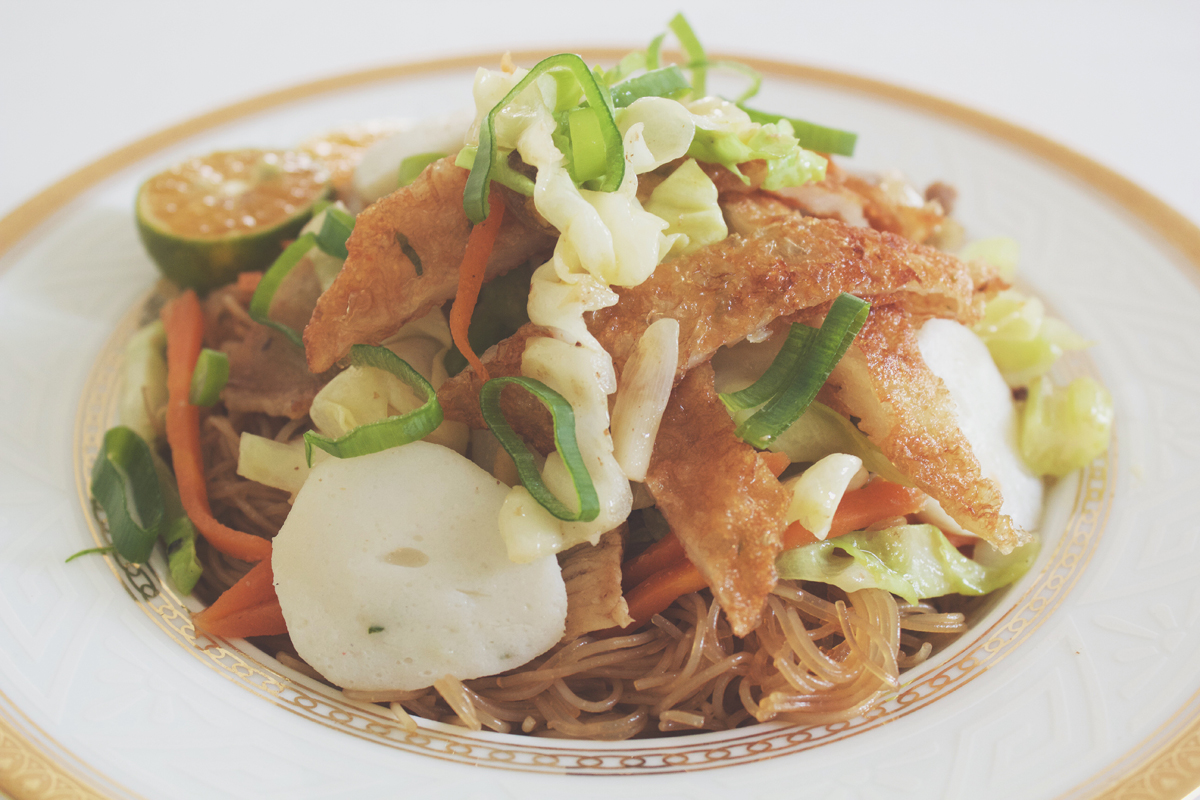
Pancit Bihon Guisado (Filipino Style Stir-Fried Rice Noodles)

When one says pancit, it is usually associated with bihon, which is a recipe that uses very thin rice noodles, fried with soy sauce, some citrus, possibly with some fish sauce as well, and some variation of sliced meat and chopped vegetables. The composition of bihon varies quite a lot because it depends on your personal recipe. I can say that the recipe that I will be sharing with you today did even start out like this when my mom first made it for the family – the ingredients have definitely changed over the years! So don’t be afraid to improvise or get creative with the ingredients; s’long as you’ve got the base of the noodles covered with this recipe. You can even take all the meat out and replace the chicken stock with veggie stock for an all vegetarian pancit bihon guisado!

Pancit Bihon Guisado (Filipino Style Stir-Fried Rice Noodles) Ingredients

PREP TIME 15 MINS | COOKING TIME 30-45 MINS | SERVES 8-10

INGREDIENTS

  • 450g bihon noodles
  • 100g fish balls, halved
  • 100g thin fish cake, sliced diagonally
  • 3 pcs dried bay leaves
  • 2-3 garlic cloves, minced
  • 2 celery stalks, sliced
  • 2 pcs thin sliced pork belly, cut into 1cm chunks
  • 1 carrot, julienned
  • 1 chicken crown, breasts removed and sliced, bone reserved
  • 1 small brown onion, diced
  • 1/2 a head of cabbage, sliced
  • 4-5 cups chicken stock
  • 1 tbsp dark soy sauce
  • 1 tbsp fish sauce
  • 1 tbsp oyster sauce
  • Ground black pepper and salt, to taste
  • Spring onions, sliced
  • Whole black peppercorns

METHOD

  1. Add the reserved chicken bone, dried bay leaves, about a teaspoon or two of whole black peppercorns, and salt to a medium-sized pot filled with about 1.5L of hot/boiling water. Turn the heat up to high and leave to boil for about 30 minutes.
  2. Meanwhile heat a large frying pan over medium-high and add in the chunks of pork belly. Cook until browned. The oils released from the pork belly should be enough to sautĂ© the garlic and cook the onions, but if needed, add a little bit more oil if there isn’t enough. Then add the minced garlic and sautĂ© until fragrant and golden brown, about a minute, then followed by the diced onions. Cook until soft, about 2 minutes in total.
  3. Add in the sliced chicken breasts, fish balls, and sliced fish cakes. Season with a bit of salt and ground black pepper and give it a good mix. Cook for about 5 minutes. Then add in the carrots and celery. Mix well and leave to cook for a further 2-3 minutes. Lastly, add in the cabbage and spring onions, and cook until just slightly wilted. Once done, transfer to a bowl and set aside.
  4. In the same frying pan, add the chicken stock to the pan together with the soy sauce, fish sauce, and oyster sauce. Bring to a boil. Once boiling, add the bihon noodles in and cook until all the liquid has evaporated. Make sure that while cooking, you mix and untangle them periodically. Altogether this should take about 10 minutes. Halfway through, add in half of the cooked meat and vegetables to the noodles and mix well.
  5. Serve immediately topped with the extra meat and vegetables, and with calamansi, or alternatively a lemon wedge. Enjoy!

Pancit Bihon Guisado (Filipino Style Stir-Fried Rice Noodles)

Pancit Bihon Guisado (Filipino Style Stir-Fried Rice Noodles)

BON APPÉTIT

– Ally xx

myTaste.com

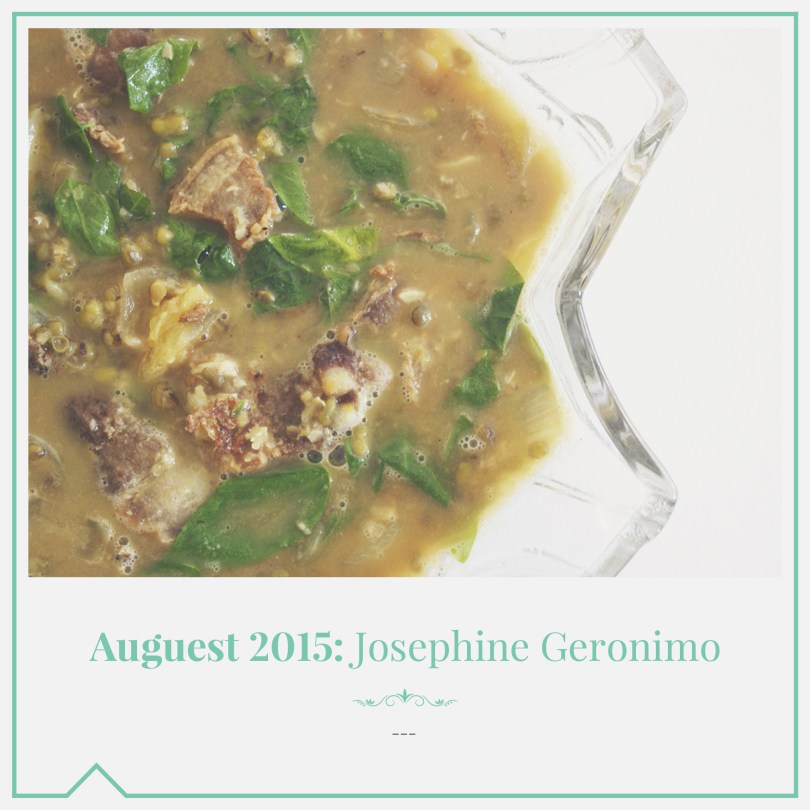
Auguest 2015: Josephine Geronimo

Munggo Guisado (SautĂ©ed Mung Bean Soup)

Hello Everyone and welcome to the final week of Auguest! If you’ve read all the way to the end of my post yesterday, you’ll know that I’ve said that week 4 of Auguest would commence today seeing as I had a special post that went up live yesterday. Today’s guest won’t be communicating with you through the write up only because she’s not that confident with her English writing skills; so instead I will be the one taking you through her story of this dish. But first, who’s my guest for this week? Of course it is none other than the woman who cooked for me throughout my years of growing up and the woman who taught me how cook. Without her, my passion for cooking would’ve probably never existed, and neither would this blog. Today’s guest blogger is none other than my Mother, Josephine, known to many as Mama G!

This dish is a delicacy from one of the Ilocanos provinces, my Mom’s hometown in the Northern part of the Philippines, Pangasinan, but her family grew in Quezon City. Once a year the whole family would travel the province to visit their farm and bring back some of their produce, one of them included one 50kg sack of munggo (mung beans). Munggo Guisado is a common lunch and dinner dish found on their table as it is a healthy and nutritious dish. Her father (my grandfather) would always remind his children that munggo contains the same amount of proteins that can be found in beef, chicken, pork, and other meats. Her father was a little bit on the stingy side, so their Munggo Guisado contain no meat at all, just pure mung beans and other vegetables such as ampalaya (bitter gourd) leaves or malunggay leaves. Her father even planted a malunngay tree so that they could pick their own leaves instead of having to go to the markets to buy it. The dish would then be flavoured with bagoong isda (anchovy sauce). It was a dish that they had for both lunch and dinner, everyday.

Munggo Guisado (Sautéed Mung Bean Soup)

This dish was introduced to my Mom since she started to eat solid foods, and has been a part of her daily meal until she came to Brunei. She stopped eating it because she wasn’t in a cooking mood since she moved out of the Philippines to work in Brunei. She started cooking it again when she had a family of her own. My Mom did the same thing by introducing this dish to me when I started to eat solid foods. To her surprise, I hated this dish and she didn’t know why. Even my two younger sisters hated it. She tried everything to make it more appetising for us by adding meat and/or prawns, but still she could not get us to eat it. So, she had no choice but to stop cooking it.

But now, after 20 years, she was able to introduce it back to us again (mainly because for this Auguest post as it has a story to tell of her roots), and apparently we love it! I kept asking my Mom why I didn’t like it in the first place, and she kept answering, “I don’t know with you!” Now Munggo Guisado has found it’s way back into our table as a regular, weekly, meal. The dish is best served with steamed rice and fried fish, as they would say “magkakambal sila” – twins, or meaning a well paired dish.

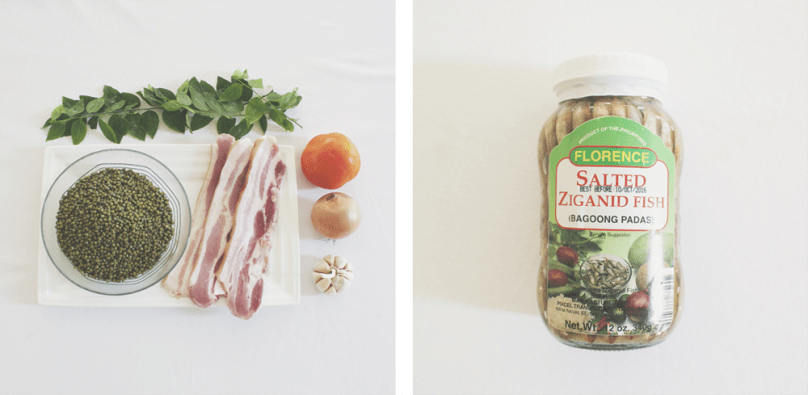
Munggo Guisado (Sautéed Mung Bean Soup) Ingredients

PREP TIME 1 HOUR | COOKING TIME 30 MINS | SERVES 6

INGREDIENTS

  • 1 cup mung beans
  • 1 cup malunggay (or ampalaya) leaves
  • 250g pork belly, sliced
  • 2-3 garlic cloves, minced
  • 1 large onion, diced
  • 1 large tomato, diced
  • 1 tbsp salted ziganid fish (bagoong padas, or anchovies)
  • Ground black pepper

METHOD

  1. Soak the beans in water for about an hour or two, this will help soften the beans and lessen the time required to boil and tenderise the beans when it comes to cooking them.
  2. Add the beans to a medium-sized pot together with about 1L of water and bring to a boil. Once boiling, let the beans simmer for about half an hour until soft (or about 50 minutes if you didn’t pre-soak them).
  3. In a medium-sized deep fry pan, add the sliced pork belly and fry until browned, about 3-4 minutes. Move them to one side of the frying pan and add the garlic. You shouldn’t need to add any oil and the natural oils from the pork fat should be enough to sautĂ© the garlic. Once the garlic is golden brown in colour and is fragrant, add in the onions and cook until soft. At this point, you can mix them together with the pork. Add in the tomatoes, season with a bit of ground black pepper, and cook until softened, about 5 minutes.
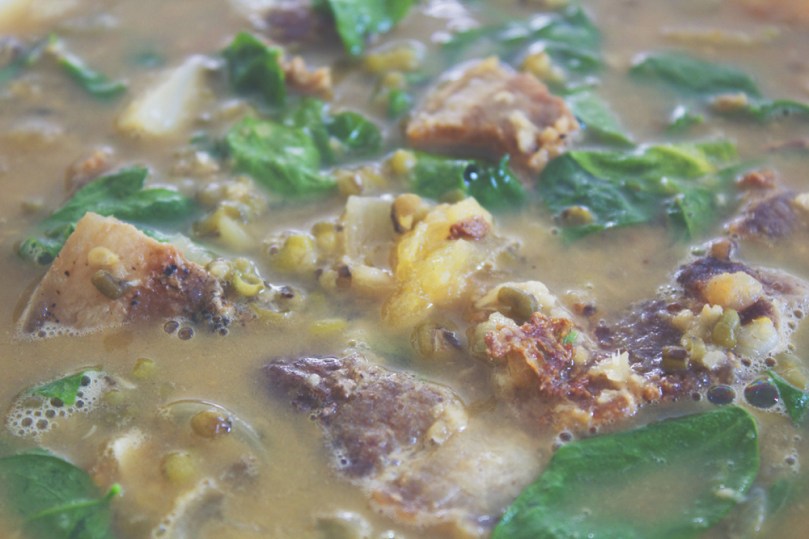
  4. Pour the cooked mung beans, together with the water that it was simmered in into the pork and tomato mixture. Give it a good mix and if it’s looking a bit dry, add more water to make it more into a soup. Bring to light simmer.
  5. Add the tablespoon of anchovies to a small bowl with about a few heaped tablespoons of the munggo soup. Press on the anchovies to get the flavours out and strain the sauce/paste back into the soup. Discard the anchovies.
  6. Simmer for another 10 minutes or so and then add in the malunggay leaves. Turn the heat off and give it a good mix, until the malunggay leaves have wilted into the soup.
  7. Serve with a nice bowl of steamed rice and fried fish. Enjoy!

Munggo Guisado (Sautéed Mung Bean Soup)

Munggo Guisado (Sautéed Mung Bean Soup)

Of course this dish can be an all vegetarian dish just as how my Mom ate it when she was growing up; just remove the pork belly!

While my Mom was telling me the story of this dish, she teared up a little as it brought back many childhood memories. I hope that one day I’ll have kids of my own and share with them the many favourite dishes I grew up with and the stories that come with them 🙂

BON APPÉTIT

– Ally xx

myTaste.com