Balado with Ai Manas (Fried Boiled Egg with Chilli Sauce)

Balado with Ai Manas (Fried Boiled Egg with Chilli Sauce)

Hello Everyone! Who here doesn’t love eggs? Eggs are probably one the the reasons why I don’t think I’d ever be able to go on a fully vegan diet. It’s amazing how many varieties of dishes we can make using the eggs as a side or main ingredient. So put your hands up if you love eggs!

To be perfectly honest, boiled eggs are my least favourite from all of the basic ways to cook eggs. Since I like a runny yolk, my absolute go-to would be sunny-side up eggs (with browned, crispy edge that gives a certain nutty flavour to the white) and/or poached eggs. I guess it’s now safe to say that the recipe that I will be sharing tonight has changed the way I see boiled eggs. Now, if you’re like me and this recipe doesn’t convert you, then I don’t know what will!

Balado with Ai Manas (Fried Boiled Egg with Chilli Sauce)

Here’s a great way to turn boring and plain-old boiled eggs into a spectacular appetizer or side dish at home. The East Timorese version of Balado is an adaptation of the original Indonesian Spicy Eggs, known as Telur Balado. Balado is a popular snack that you can find being sold, usually by children, all over the streets of East Timor. If you want a flavourful egg dish where the sauce penetrates all the way into the inside, then you really want to develop a fried and crispy skin to your eggs. Likewise, you can serve this dish with a fried egg or sunny-side up, but tradition calls for boiled eggs.

On the streets for just 25 cents, you get a fried, hard-boiled accompanied by a bold sour and spicy chilli sauce, called Ai Manas. Ai Manas is the heart of every East Timorese food. It’s very famous all over the country and comes with many regional varieties that vary according to taste. Green or red chillies often make up the bulk of the ingredients of the paste. The chilies are grounded along with lime or lemon rind and juice, ginger, onions, and several other local spices. Even a teaspoon of this sauce is enough to fire up any meal. Thai chillies are usually used for this sauce, which can be significantly hot for some. Use what you like and can tolerate.

Balado with Ai Manas (Fried Boiled Egg with Chilli Sauce) Ingredients

PREP TIME 10 MINS | COOKING TIME 10 MINS | SERVES 6

INGREDIENTS

  • 6 large free-range eggs

For the spicy chilli sauce

  • 8-10 pc red bird’s eye chillies, roughly chopped
  • 2 garlic cloves, finely minced
  • 1 small red onion, finely diced
  • 1-2 tsp white granulated sugar (optional)
  • Handful of Thai basil, roughly chopped
  • Salt, to taste
  • Small thumb-sized ginger, grated
  • Zest and juice of 1 lemon

METHOD

  1. Ai Manas: Using a mortar and pestle, pound the chillies, garlic, and red onion into a rough paste.
  2. Follow with the grated ginger, lemon zest, and a pinch of the basil leaves. Continue to pound and season with a touch of salt. Add in the lemon juice and give it a good mix. Taste and adjust to your liking.

I had to add about a teaspoon or two of white granulated sugar to balance the spice and tang of the sauce. You don’t have to add it if you’re alright with the level of sour and spice.

  1. Once done, add the rest of the chopped basil leaves to the sauce, mix, and then set aside.

Balado with Ai Manas (Fried Boiled Egg with Chilli Sauce)

  1. Balado: To boil the eggs, heat a medium-sized pot of water (enough to cover all the eggs) over high heat until boiling. Once boiling, turn the heat down to low and carefully place the eggs in the pot using a ladle to prevent them from cracking.
  2. Depending on your preference, boil for 5 minutes for soft-boiled eggs, 7 minutes for medium eggs, or 10 minutes for hard-boiled eggs. Take note that you’ll be cooking the eggs again, so I would recommend you go for soft or medium eggs if you don’t like over-cooked boiled eggs as a result.
  3. While the eggs are cooking, prepare an ice bath* by combining ice and tap water in a large bowl. Once the eggs are cooked, immediately transfer them to the ice bath to cool for 2 to 3 minutes.
  4. Peel the eggs and make sure to pat them dry if you don’t want them to explode while frying.
  5. Heat oil, enough to submerge an egg for deep frying, in a medium-sized pot over medium high. Carefully lower the eggs into the oil and fry until golden brown, about 2-3 minutes.
  6. Carefully remove from the oil using a slotted spoon and transfer to a plate lined with a paper towel to absorb any excess grease.
  7. Serve the fried boiled egg with the spicy chilli sauce and enjoy while hot!

Balado with Ai Manas (Fried Boiled Egg with Chilli Sauce)

*The ice bath will cool the eggs quickly and stop the cooking process. The ice water will also cause the egg to contract and pull away from the shell, which will make it easier to peel.

BON APPÉTIT

– Ally xx

myTaste.com

Num Treap (Sticky Rice with Sesame Seeds)

Num Treap (Sticky Rice with Sesame Seeds)

Hello Everyone! Forget about brownie sundaes, forget about éclairs and chocolate cake; the real desserts, the sinfully sweet and decadent treats, can be found in one region: Southeast Asia. Ingredients in Southeast Asian treats are less traditional than the sweet flavours you typically see in Western desserts. Ingredients like cassava, mung beans, and lotus seeds paired with sticky sweet syrups like coconut cream, palm syrup, and condensed milk are common and no strangers to Cambodian treats. Beyond these ingredients you can also always expect to have at least one fresh fruit added to the mix. Look for favourites like mangoes, rambutan, durian and of course, bananas.

Just as Southeast Asian desserts, Cambodian treats are most frequently enjoyed mid-morning. Instead of being served to cap off a delicious meal, the treats are bought and enjoyed in markets as you are doing your shopping around town. Many of the most popular Khmer treats are sold from mobile street stands. Look out for the crowds of students outside universities and schools, flocked around a stand.

Traditional Cambodian treats, also known as Khmer sweets, also come in the form of custards and puddings; egg-based dishes that are spiced up with a variety of flavours (vanilla and cinnamon are typical favourites). Since rice remains a main staple in current day cuisine, being eaten as often as three times a day, rice-based cakes are also very popular.

Num Treap (Sticky Rice with Sesame Seeds)

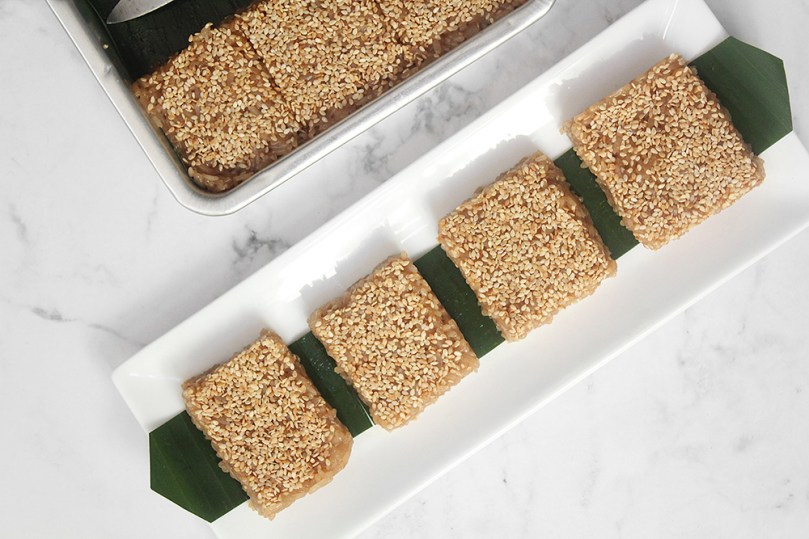
Tonight, I will be sharing a Cambodian favoured treat that is simple and super easy to make at home. The best part? You’ll most likely have everything readily available to whip this up in your pantry. Num Treap, or in English, Sticky Rice with Sesame Seeds, is a treat that is basically as the name states, steamed sticky rice mixed in a warm coconut sauce. The mixture is then spread into a baking dish or pan, topped with sesame seeds, and then set aside to cool before cutting into squares and then served. You may serve it as it is, or with fruits on the side. Num in Cambodian means pastry, so it is essentially a sticky rice (bai damnaeb) pastry treat.

This dessert is very much similar to a sweet rice cake that we have here in the Philippines known as Biko. It is also made of coconut milk, brown sugar, and glutinous rice, that is topped with latik (coconut curds) instead of sesame seeds.

Num Treap (Sticky Rice with Sesame Seeds) Ingredients

PREP TIME 60 MINS* | COOKING TIME 45-60 MINS | MAKES 9 SLICES

*Allow for an additional 6 hours (or more) to soak the glutinous rice before cooking.

INGREDIENTS

  • 1 cup sweet glutinous rice, soaked for at least 6 hours or overnight
  • 2/3 cup coconut milk
  • 1/2 cup coconut sugar
  • 3 tbsp sesame seeds, toasted
  • 2 tsp vanilla extract
  • 1/2 tsp salt

METHOD

  1. Rice: Drain the water (no need to shake off the excess water), and evenly arrange the soaked sticky rice in a steamer lined with a greased banana leaf.
  2. Cover and steam for 30-45 minutes. You can check the rice and increase the steaming time if need be. Once done, keep the rice in the steamer or covered to prevent it from drying out until you need to use it.
  3. Coconut Sauce: While the rice is cooking, add the coconut milk, coconut sugar, salt, and vanilla extract in a large saucepan and cook over medium-high heat. Stir frequently until it thickens, about 5 minutes.
  4. Num Treap: Fluff the cooked rice with a fork to separate the grains. With the heat off, add the rice to the saucepan with the coconut sauce and mix well.
  5. Spread the rice mixture into a shallow dish or baking pan, pressing them down with a spatula. Sprinkle sesame seeds on top and cover with plastic wrap. Leave to set and cool for about an hour.
  6. Cut into squares, then serve and enjoy!

Num Treap (Sticky Rice with Sesame Seeds)

Num Treap (Sticky Rice with Sesame Seeds)

BON APPÉTIT

– Ally xx

myTaste.com

Kuih Koci Gula Kelapa (Glutinous Rice Cake with Coconut Filling)

Kuih Koci Gula Kelapa (Glutinous Rice Cake with Coconut Filling)

Hello Everyone! Tonight I will be sharing my last recipe from Brunei. As previously mentioned in a post I shared two weeks ago, I came across this Kuih Koci Gula Kelapa from the same website entitled ‘Brunei’s Traditional Sweet Treats You Must Try’.

To be honest, when I was still living in Brunei, this was a kuih that I barely saw sold in the night markets or road-side stalls – or maybe I was too focused on my favourite kuih-kuih that I failed to notice them amongst the pack. Nevertheless, as with most, if not all, kuih-kuih found in Brunei originate from a different country, and the Kuih Koci Gula Kelapa is no stranger to that. As it turns out, it is actually native to Indonesia.

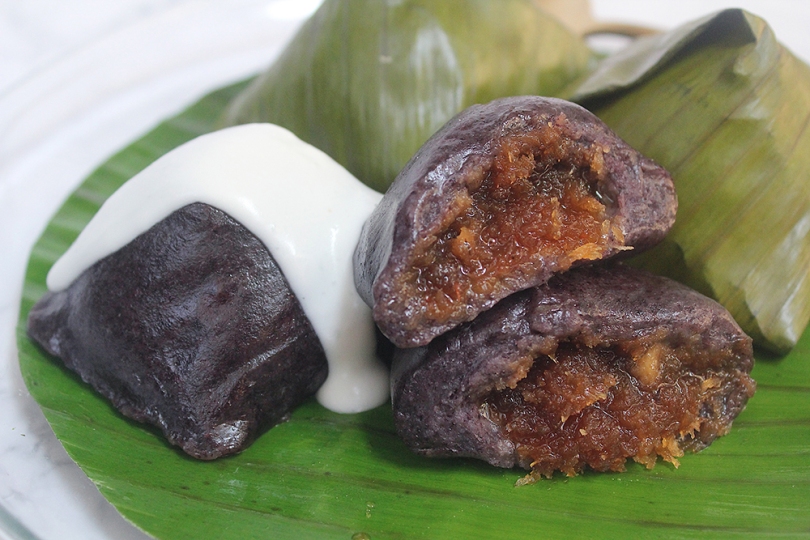
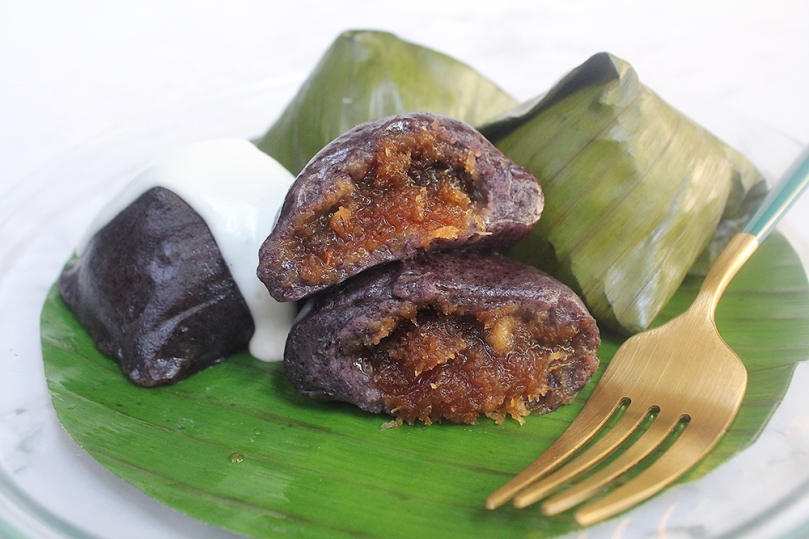
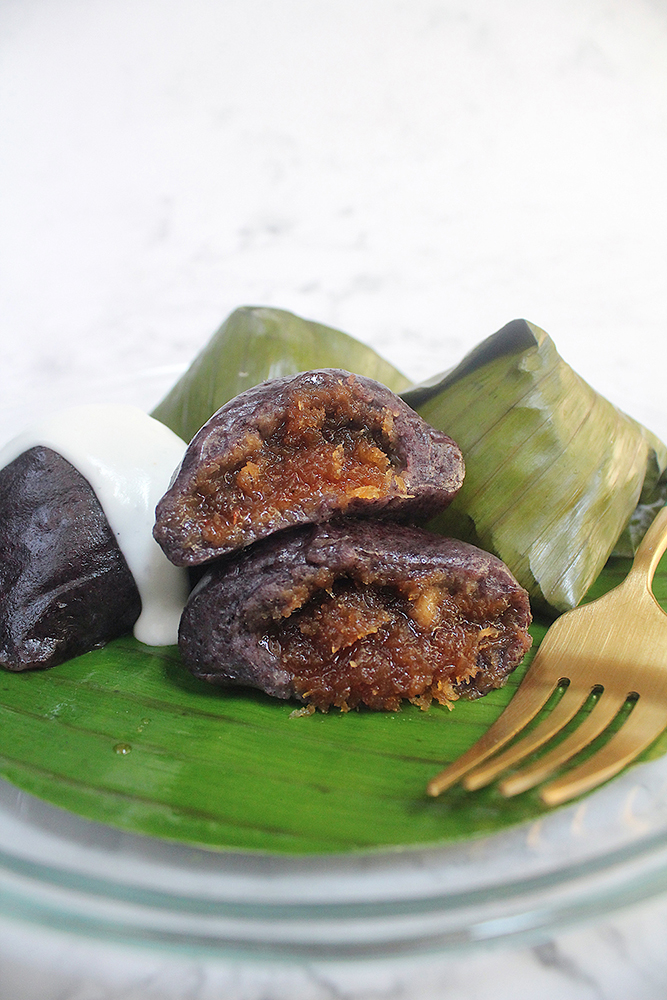
Pronounced koh-chee, this is a snack/dessert made with a mix of white and black glutinous rice flour, stuffed with sweetened coconut and palm sugar filling, wrapped in banana leaves, and then steamed. The deep purple hue of the kuih comes from the black glutinous rice flour. There are also varieties of this kuih that do not require black glutinous rice flour, in fact a majority of it is made with white glutinous rice flour. The black glutinous rice flour is mainly used to colour the kuih.

Kuih Koci Gula Kelapa (Glutinous Rice Cake with Coconut Filling)

In fact, black glutinous rice flour may be quite difficult to source (depending on where you live). You can actually make your own too by grinding black glutinous rice grains. Place them in a coffee grinder or blender and then grind until really fine. Sieve the flour and then grind again. You need to grind several times until you get a really fine flour, so technically it’s a lot of work too. I managed to source mine online from Indonesia.

The Kuih Koci has a mochi-like texture and is sweet in flavour from the coconut filling inside. Though optional, a slightly salty coconut sauce cuts through the sweetness nicely. Other than just adding a dollop of it atop after the kuih has been steamed, you can also spoon the coconut sauce into the banana leaf, place the dough in, and then steam it with the coconut sauce.

Before we dive into tonight’s recipe, please take the time to check out the original where I drew my inspiration from over on What To Cook Today by Marvellina.

Kuih Koci Gula Kelapa (Glutinous Rice Cake with Coconut Filling) Ingredients

PREP TIME 30 MINS | COOKING TIME 30 MINS | MAKES 6 PCS

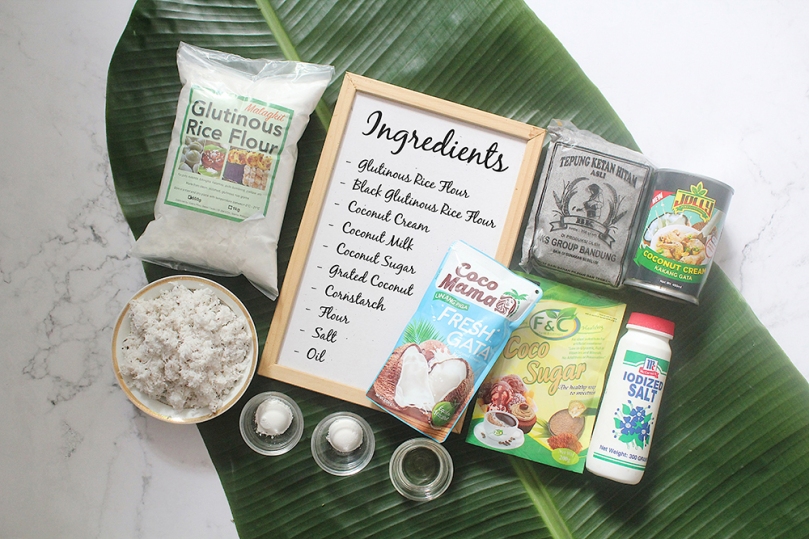
INGREDIENTS

For the dough

  • 1 & 1/2 cups white glutinous rice flour
  • 1/3 cup black glutinous rice flour
  • 2/3 cup coconut milk

For the coconut filling

  • 2 cups grated coconut
  • 1/2 cup coconut sugar*
  • 1/4 cup coconut cream
  • 1/4 cup white granulated sugar**
  • 1 tsp cornstarch
  • 1/4 tsp salt

*Gula Melaka (palm sugar) is the choice of sweetener used when it comes to traditional kuih like this, but if you can’t seem to source it, you can always substitute it for coconut sugar like I did.

**Also, I ran out of coconut sugar. It’s supposed to be 1 cup of coconut sugar but I only had half a cup left and therefore mixed it together with a quarter cup of white granulated sugar.

For the coconut sauce (optional)

  • 2/3 cup coconut cream
  • 1 tsp all-purpose flour
  • Pinch of salt, to taste

Wrapping

  • 6 pcs banana leaves (15cm x 20cm)
  • Coconut oil, for brushing

METHOD

  1. Prepare the Banana Leaves: Soak the banana leaves in warm water for 30 minutes. Wipe them dry and brush with coconut oil. Set aside.
  2. Coconut Filling: Meanwhile, add the coconut cream and sugars in a pan over medium heat. Mix until the sugars have melted, then stir in the grated coconut and salt. Mix until well incorporated and then sprinkle the cornstarch over the coconut-sugar mixture. Stir and cook until the mixture thickens. Once done, set aside and let it cool down completely.
  3. Coconut Sauce: Add the coconut cream and a pinch of salt to a small saucepan. Whisk in the all-purpose flour until smooth. Place on the stove and cook over medium heat, whisking continuously until the sauce thickens. Set aside.
  4. Dough: Heat the coconut milk in a small saucepan until it is hot, but not boiling. Add both flours to a large mixing bowl, together with the hot coconut milk. Stir to mix everything, until the dough comes together. It should be pliable and not sticky.
  5. Divide the dough into 6 equal pieces. Flatten the dough with the palm of your hands and place the cool coconut filling in the middle. Wrap around it and roll the dough into a smooth ball. Repeat with the remaining dough.
  6. Wrapping: Take a piece of banana leaf and shape into a cone. Place a dough ball in the cone and gently push it into the leaf. Fold one side over, and then the adjacent side. Then fold the other two sides to make your cone-shaped Kuih Koci.

You may also choose to wrap them into a parcel, or steam them with no wrapping at all! Just place the balls onto a small sheet of banana leaf.

  1. Steaming: Place the wrapped Kuih Koci into a steamer and steam for about 10 -15 minutes.
  2. Serve: Once done, unwrap and serve immediately while hot, topped with the coconut sauce. Enjoy as a light mid-morning or mid-afternoon snack!

Kuih Koci Gula Kelapa (Glutinous Rice Cake with Coconut Filling)

Note: Steamed Kuih Koci can be kept in the refrigerator for up to 3 days. Otherwise, you may freeze the uncooked kuih koci for later consumption. Steam, frozen for, 15-18 minutes.

BON APPÉTIT

– Ally xx
myTaste.com

Nasi Katok with Buttermilk Salmon

Nasi Katok with Buttermilk Salmon

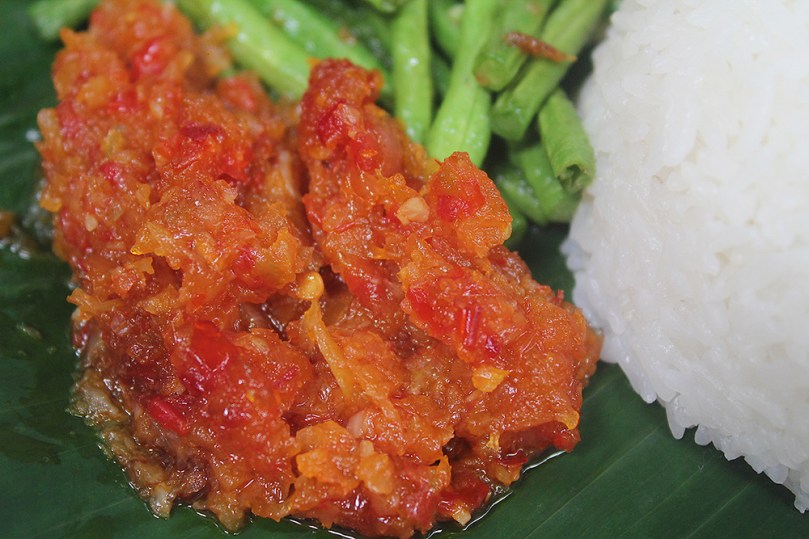
Hello Everyone! We’re pushing on with more Bruneian favourites, and this month wouldn’t be complete without tackling the famous Nasi Katok, which in English literally means ‘knock rice’. It is a simple combination of white rice, sambal (a condiment made out of blended chillies and other spices), and a piece of fried chicken, traditionally served wrapped in a piece of waxed brown paper. A variety of secondary ingredients including but not limited to shrimp paste, garlic, ginger, shallot, scallion, palm sugar, lime juice, vinegar, and anchovies can also be served together with the fried chicken.

Nasi Katok is as quintessentially a Bruneian version of fast food, with many vendors running around the clock 24 hours a day selling this classic favourite. The roots of the term originated from the act of katok (knocking), on the window of this small flat in the country’s capital, to buy nasi (rice); the unofficial first Nasi Katok establishment since the 1980s. Naturally, the name stuck and today the dish is among the best national dishes.

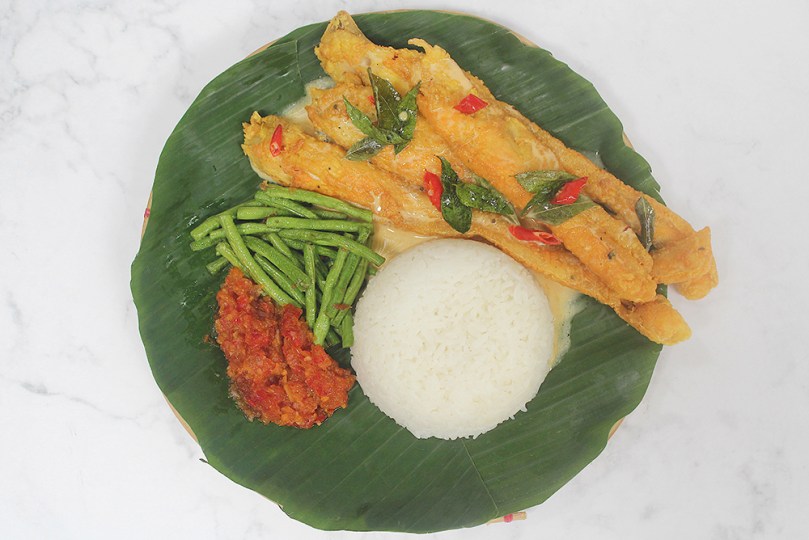
Nasi Katok is one of Brunei’s most affordable staples that is priced at only BND$1.00. That’s right, one dollar for a piece of fried chicken, sambal, and steamed white rice. Over the decades the Nasi Katok has evolved into many versions – my favourite being the fusion of chicken and buttermilk.

Nasi Katok with Buttermilk Salmon

Bruneians love their buttermilk chicken, so when word got out that there was a place in Brunei that combines two of the country’s most loved foods, it caused a sensation! As of the majority of the dishes found in Brunei, the origins of buttermilk chicken is actually a Malaysian dish known as Lai Yao Kei 奶油鸡, or Malaysian Butter Chicken. It is about a million miles away from what most of us imagine when we think of Butter Chicken (and I’m talking about the Indian variety).

Other than chicken being the main source of protein for the dish, other meat varieties such as pork, fish, and prawns can be found too. I decided to keep mine pescatarian friendly for this recipe and so I used salmon belly for this dish. The buttermilk sauce is infused with the aroma of fresh curry leaves, and spiked with the heat from fresh chillies. It is actually very simple to make and comes together in just minutes. Though you’d think the butter would be the star of the show here, it is actually the evaporated milk that steals the limelight!

Nasi Katok with Buttermilk Salmon Ingredients

PREP TIME 30 MINS | COOKING TIME 30 MINS | SERVES 6

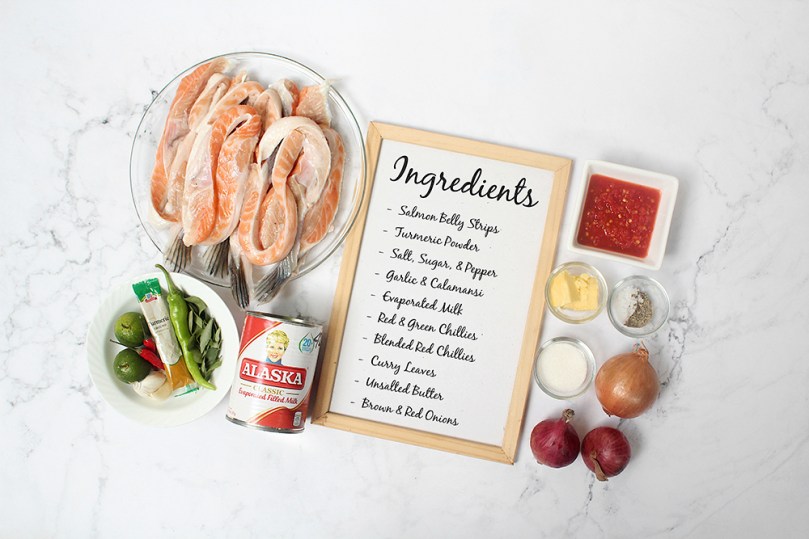
INGREDIENTS

For the salmon

  • 6 pcs salmon belly strip, scaled and cleaned
  • 3 garlic cloves, finely minced
  • 2 pcs calamansi, juiced
  • 2 tsp turmeric powder
  • Salt & freshly ground black pepper, to taste
  • All-purpose flour

For the buttermilk sauce

  • 1 can (300ml) evaporated milk
  • 1 bunch (8-10 pcs) curry leaves
  • 2 pcs red bird’s eye chillies, chopped
  • 1 tbsp unsalted butter
  • 2 tsp white granulated sugar
  • Salt & freshly ground black pepper, to taste

For the sambal

  • 3 garlic cloves, chopped
  • 2 small red onions, peeled and quartered
  • 1 medium-sized brown onion, quartered
  • 1 long green chilli, chopped
  • 1/2 + 1/2 cup water
  • 3 tbsp blended red chillies
  • 1 tbsp white granulated sugar
  • Salt, to taste
  • Cooking oil

METHOD

  1. Salmon Belly: Add all the ingredients into a medium-sized bowl and mix well. Set aside to marinate for at least 30 minutes before cooking.
  2. Lightly coat the salmon belly strips in flour and shallow fry until golden brown and crispy. Fry in batches if needed and once done, set aside. You can fry the salmon bellies just before serving so that they are hot and remain crispy.
  3. Sambal: Add the onions, garlic, green chilli, and half a cup of water into a food processor or blender. Blend until the ingredients are finely chopped.
  4. Add about 2 tablespoons of oil in a medium-sized pan over medium heat. Add the onion mixture and cook until soft and fragrant, about 5 minutes.
  5. Add the blended red chillies and continue to cook for a further 2 minutes. Season with a pinch of salt, add the sugar, and the remaining half cup of water. Give it a good mix and continue to cook until thickened. Once done, set aside.
  6. Buttermilk Sauce: Melt the butter to a medium-sized pan over medium heat. Once melted, add the red chillies together with the curry leaves and cook to infuse the flavours and aromas into the butter. Set aside a few curry leaves and chillies for decoration later.
  7. Turn the heat down to medium-low and add the evaporated milk. Add the sugar and season with a touch of salt and freshly ground black pepper. Taste and adjust to your liking. Cook until the sauce thickens, about 8 to 10 minutes altogether.

At this point, you can either add the fried salmon bellies to the sauce and simmer for a couple of minutes before serving, or top the bellies with the sauce. It’s completely up to you.

  1. Serve with rice and vegetables of choice, together with sambal. Enjoy!

Nasi Katok with Buttermilk Salmon

Nasi Katok with Buttermilk Salmon

Before I end tonight’s post, there’s something I want to share with everyone. So about two weeks ago I came across a post on Instagram regarding the price of Nasi Katok – should it be increased from BND$1.00 to BND$1.50? From a survey of almost 2000 people, 58% said that it should stay at BND$1.00. Small business owners usually sell Nasi Katok just to get through the day; it was never about profit for some. In fact, vendors would only make a profit of 20 cents per serving of Nasi Katok sold. In my honest opinion, if it’s just for a 50 cents price increase to help small businesses, I wouldn’t mind paying extra especially if I’m getting more in return. Think about it, you’re getting a serving of rice, a decent-sized piece of chicken and a spicy relish to bring it altogether. I think we can spare a little more out of our pockets to help them out.

BON APPÉTIT

– Ally xx
myTaste.com

Purple Sweet Potato Rösti Eggs-in-a-Hole

Purple Sweet Potato Rösti Egg-in-a-Hole

Hello Everyone! How is it that we’re already more than half way through the last month of 2020? Where did the months in quarantine go by? Who would’ve thought that staying at home, isolated from the outside world, would actually fly by this quickly?

To be honest, never did I once feel a day go by so slowly. I’ve experienced slower days when actually in the office – the type where I’d look at the clock and it’d read 3pm. An hour later (or so I thought) and it would only read 3:05pm. At home, I’d look at the clock and it’d be 9am; 5 minutes later and it’s already 11am.

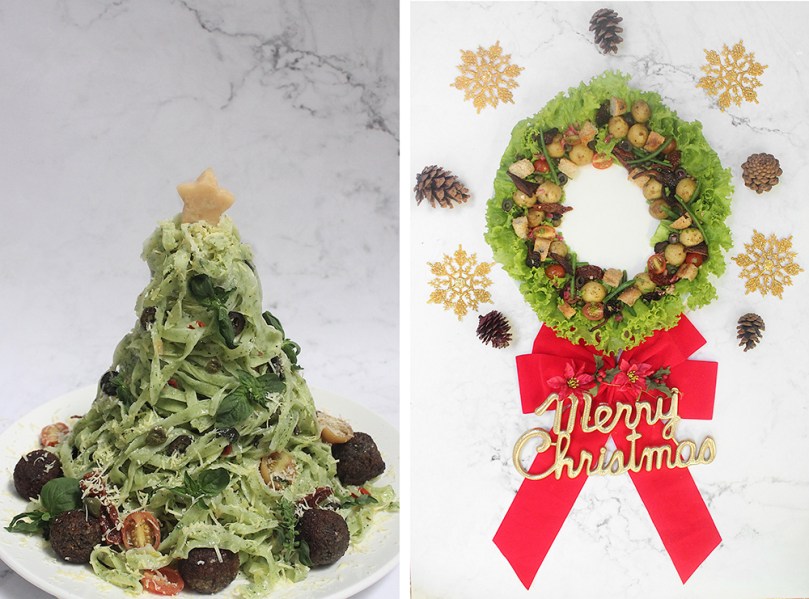
Firstly, I’d like to apologise for not uploading a new recipe on the blog for the past two weeks. I actually had this recipe ready to be posted in the first week of December, but at the last minute, I was invited to join two Noche Buena (Christmas Feast) Challenges. Here are my two entries for two separate challenges:

Christmas Noche Buena Challenges

Left: Christmas ‘Spaghetti’ with Meat-free Baubles for the #LODINGNocheBuena Challenge

The theme for this challenge was ‘Christmas Essence on a Plate’. We had to prepare a Pinoy Noche Buena dish, entailing the story behind it. I decided to take a Classic Pinoy Spaghetti and put my own healthy twist to it (you can read the full story on my Instagram account. This was a challenge set by The Official LODI LPG to the Food IG Community and I’m proud to say that I bagged the top spot and won a plus 3,000php cash!

Right: Potato ‘Wreath’ Salad for the #WVNocheBuenaCookOff2020

The theme for this cook off was ‘Christmas Like No Other’. We had to prepare a dish that’s always present on our Noche Buena table and describe how this year’s Noche Buena celebration will be different from the previous ones. This is a campaign spearheaded by World Vision Philippines to help provide Noche Buena packs to World Vision registered children and families in the Philippines. The winners for this cook off will be announced on December 22, 2020!

You can find the recipes to both my entries by clicking on the links that will direct you to my Instagram page.

So here’s a little insight first and foremost, I initially wanted to serve this dish with some smoked salmon to bulk up this brunch dish. However, since I couldn’t seem to source any from the various grocery stores I’ve been to over the course of a month, I then decided to make my own smoked salmon at home after coming across a video on how to DIY without a smoker. Of course, I got lazy and scraped the whole idea of adding smoked salmon to the dish and kept it ovo-vegetarian instead for a simple and light brunch.

Purple Sweet Potato Rösti Eggs-in-a-Hole

Rösti or rööschti is a Swiss dish that is made of potatoes in the style of a fritter. The potato, either parboiled or raw, is coarsely grated, and seasoned with salt and pepper. They are then shaped into rounds or patties and fried in either oil or butter. Rösti are most often pan-fried and shaped in the frying pan during cooking, but they can also be baked in the oven. Although the most basic of rösti consists of nothing but potato, various ingredients can be added, such as bacon, onion, cheese, apple, and/or fresh herbs. And that’s exactly what I did to put a little spin on a traditional potato rösti…

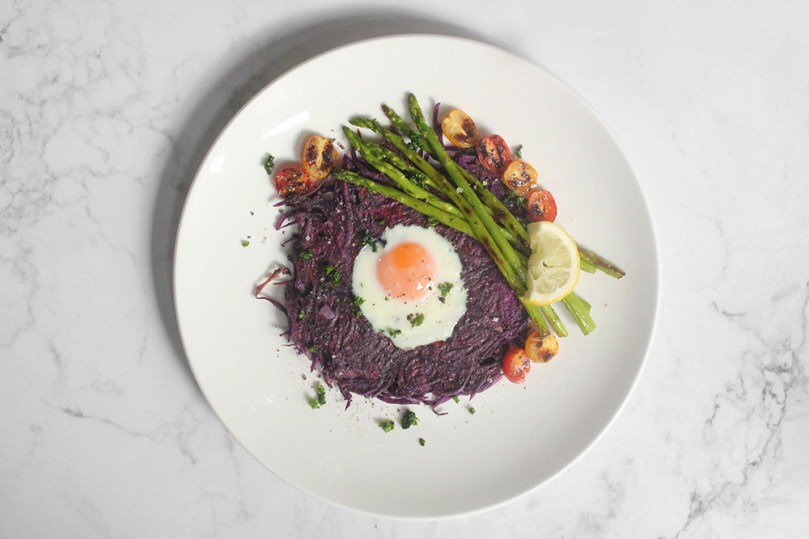
Keeping in line with our violet theme to end the year, I substituted regular potatoes for purple sweet potatoes instead and added an ‘egg-in-a-hole’ twist. An egg-in-a-hole is traditionally a piece of bread with an egg in the center, cooked with a little butter or oil. Serve with some pan-fried cherry tomatoes and asparagus on the side and you’ve got one heck of a brunch. Feel free to add any meat of choice to bulk up your brunch meal.

Newsflash! Breakfast just got a <em>hole</em> lot more interesting!

See what I did there? *cheeky wink*

Purple Sweet Potato Rösti Eggs-in-a-Hole

PREP TIME 5 MINS | COOKING TIME 25 MINS | SERVES 4

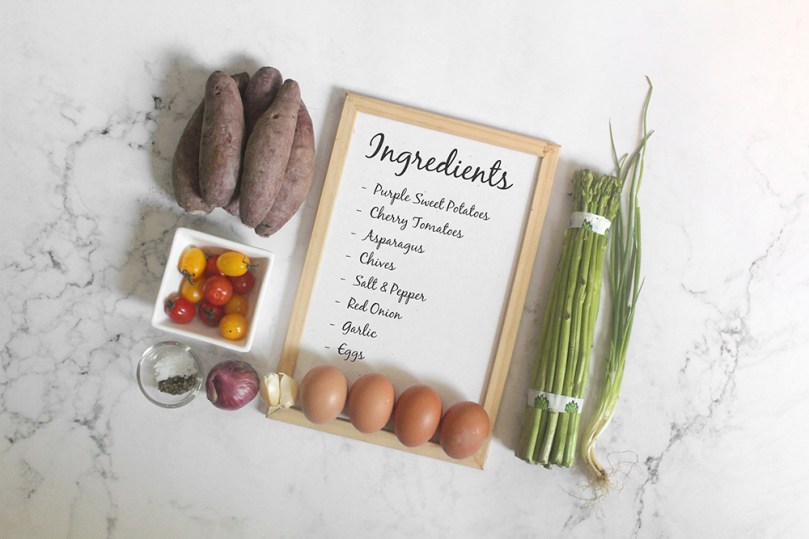
INGREDIENTS

For the sweet potato rösti

  • 2 cups shredded purple sweet potatoes (about 4 small-sized sweet potatoes)
  • 1 large free-range egg
  • 2 garlic cloves, finely minced
  • 1 small red onion, finely diced
  • 1 tsp salt
  • 1/2 tsp freshly ground black pepper
  • Olive oil, for frying
  • 4 large free range eggs
  • Asparagus
  • Cherry tomatoes
  • Chives or parsley, chopped
  • Lemon slice

METHOD

  1. Wrap the shredded sweet potatoes in a clean cheesecloth and wring out any excess moisture from it until dry. Place in a large mixing bowl and add one egg, garlic, onion, and season with salt and pepper.
  2. Heat a non-stick pan over medium-high and add oil. Add half a cup of the shredded sweet potato mixture in an even layer and cook for approximately 2 minutes or until golden and crisp. Flip and use a round cookie cutter to remove the center of the rösti.
  3. Drop an egg in the center of the rösti and cook until the whites are set. Remove the rösti from the pan and repeat with the remaining sweet potatoes until all are cooked.
  4. Top with fresh chives or parsley, and salt and pepper. Get creative at this point and serve with your choice of veggies; I went for some pan-fried asparagus and cherry tomatoes. Enjoy!

Purple Sweet Potato Rösti Eggs-in-a-Hole

BON APPÉTIT

– Ally xx

myTaste.com

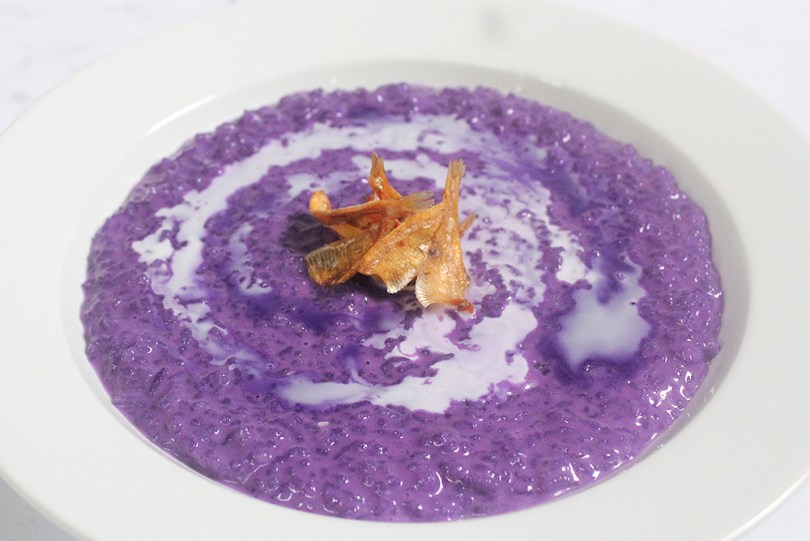
Ube Champorado

Ube Champorado

Hello Everyone! Everything is about ube these days; ube ice cream, cakes, and desserts and all that. ‘New’ recipes are being developed all the time – new meaning adding an ube twist to already classic favourites. The latest ube trend/craze to come out of this quarantine is of course none other than the overrated Ube Cheese Pandesal.

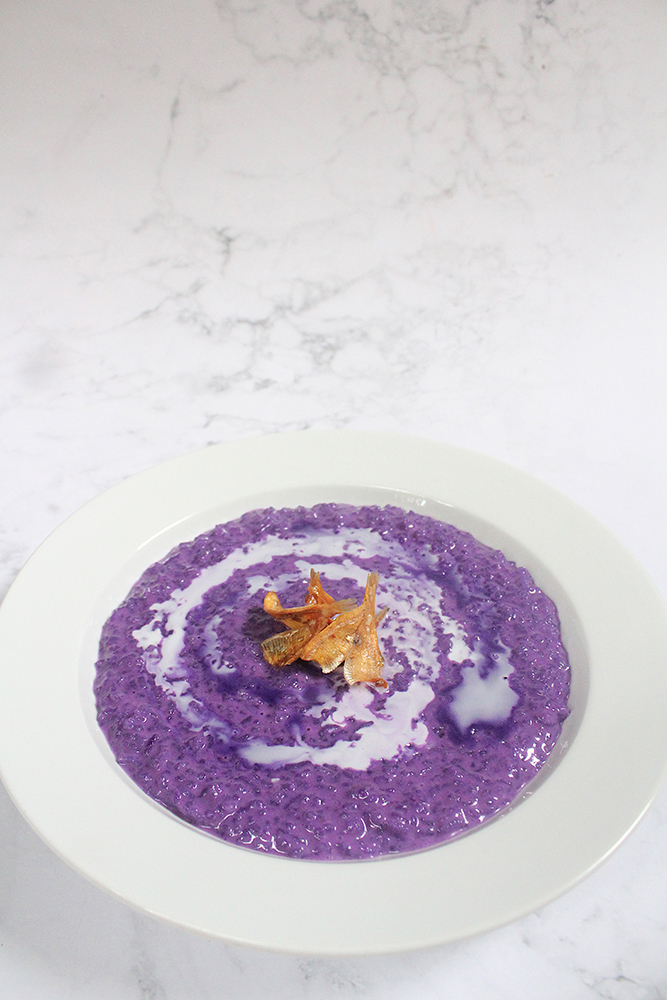
Ube Champorado

Like this Ube Champorado, it is as good as our favourite original chocolate version. Almost two years ago (just shy of a few days actually), I made the classic version of this champorado using tablea chocolate. In that post, I talked about pairing a sweet rice pudding with dried, salted fish. I remember getting messages from friends when I posted a photo of the dish on IG; all with the same “wow, that’s interesting!” reaction. There are a lot of desserts out there that embrace the salty-sweet combination; salted caramel and salted chocolate being the top two favourite bases to endless dessert options!

This Ube Champorado with dried salted fish is no exception. It adds pops of salty surprises to each spoonful of the sweet ube rice porridge that you take. If the combination is off putting for you, then you could get away with adding a pinch of rock salt into your champorado – but it won’t be the same. For all the ube lovers out there, this is an ideal breakfast, snack, or dessert for any occasion!

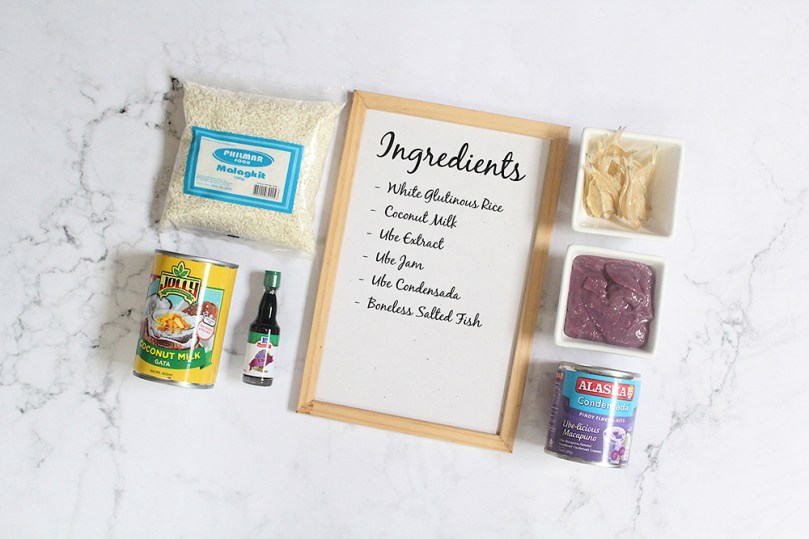
Ube Champorado Ingredients

PREP TIME 5 MINS | COOKING TIME 25 MINS | SERVES 6

INGREDIENTS

  • 4 cups filtered water
  • 1 cup (250g) white glutinous rice, rinsed
  • 1 cup ube jam/halaya
  • 1/2 cup coconut milk
  • 1 tsp ube extract
  • Pinch of salt

METHOD

  1. Add the rinsed glutinous rice together with the water in a medium-sized stockpot over medium heat. Bring to a boil and then lower the heat down to a simmer. Cook until the rice is almost tender, about 15 minutes. Stir regularly to avoid scorching and sticking. Add more water if necessary to achieve your desired consistency.
  2. Stir in the ube jam/halaya, ube extract, coconut milk, and season with a pinch of salt. Taste and adjust if needed. Cook, still continuously stirring, until tender and the ube is mixed in well with the rice, a further 10 minutes or so.
  3. Once done, ladle the champorado into individual serving bowls and top with a swirl each of the ube condensada and coconut milk. You may also top them with fried boneless dilis if you’re feeling adventurous.
  4. Enjoy immediately while steaming hot on a chilly and crisp morning!

Ube Champorado

You may use fresh/raw ube for this recipe, however, so using store-bought ube jam/halaya, ube extract, or ube powder is just as good; quick and hassle free as how champorado should be. Having to work with fresh Ube will totally ruin that aspect of a no-fuss champorado for me.

Ube Champorado

BON APPÉTIT

– Ally xx
myTaste.com

Purple Sweet Potato Crisps with Easy Roasted Garlic & Chive Aïoli

Purple Sweet Potato Crisps with Easy Roasted Garlic & Chive Aïoli

Hello Everyone! Now this is a recipe I’ve been so eager to make since forever. I first came across this dish from a café across the road from my campus when I was still studying in Australia for my design degree. The café is known as Ampersand Café & Bookstore. I did a review of the café back in 2015, so if you have some free time up your sleeves, go and have a read, or just a look at the lovely ambiance of the café and the delicious food served there.

Purple Sweet Potato Crisps with Easy Roasted Garlic & Chive Aïoli

The one thing I would never fail to order off their blackboard menu? That’s right, their sweet potato crisps with aïoli. I even remember going there several times and not being able to order this dish because their deep fryer had been broken for a couple of months. At times I would even ask them “is your deep fryer still broken?” and then make a sad face later when they would unfortunately say yes.

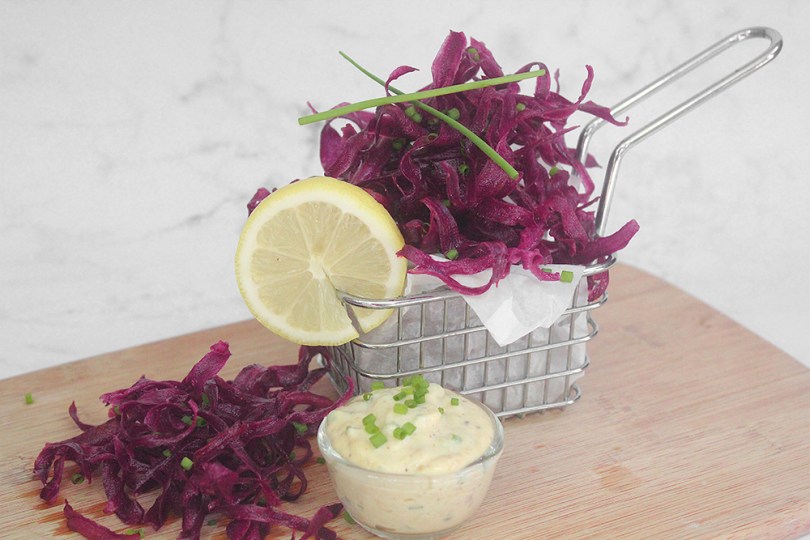
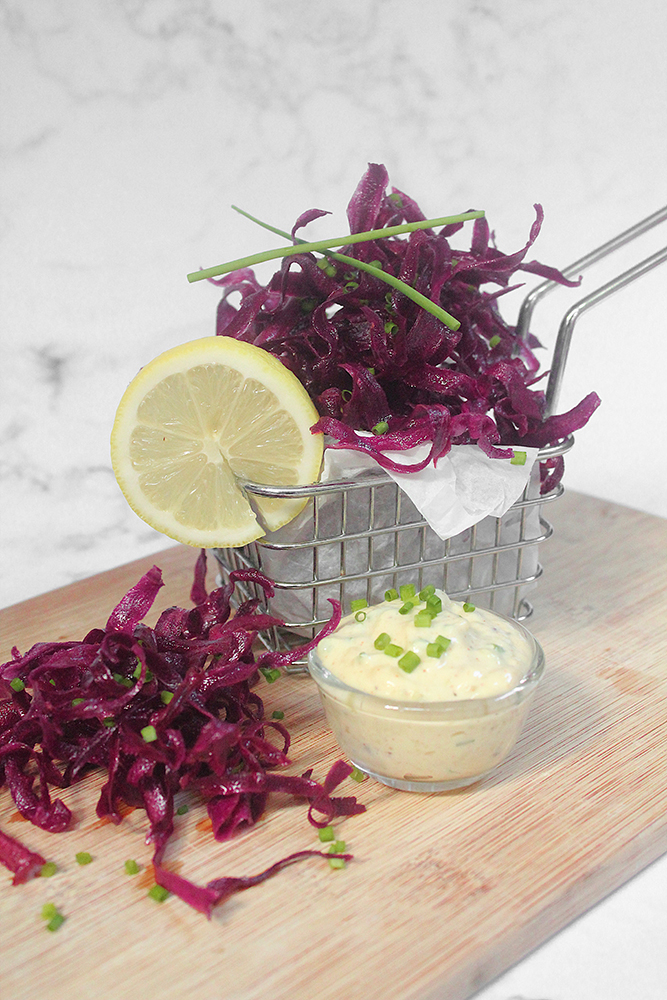
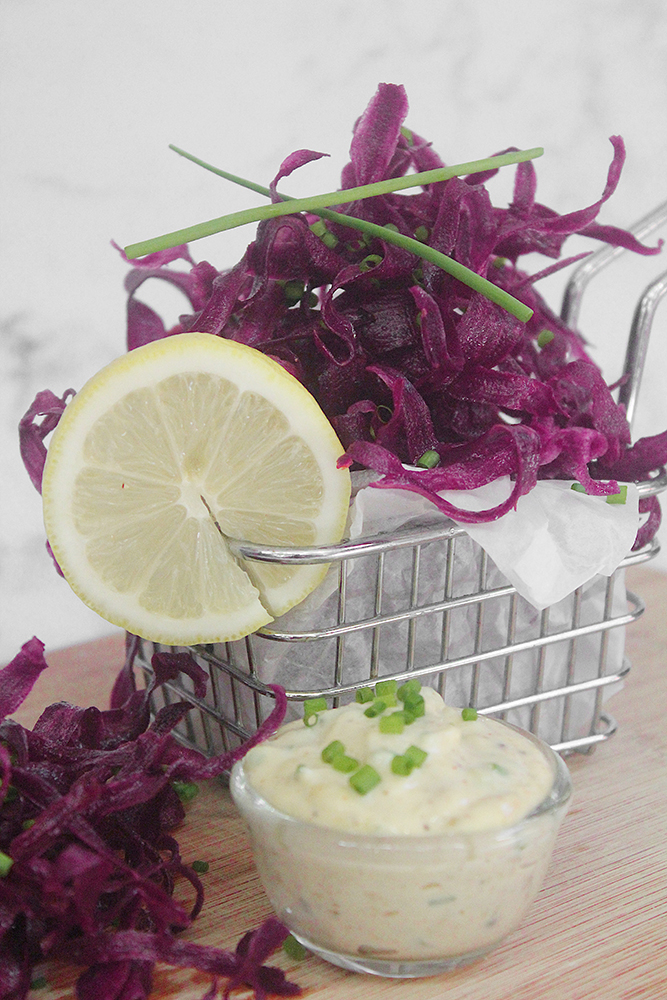
The crisps from the café are made using orange sweet potatoes, and since we’re sharing violet recipes for this month, I decided to use purple sweet potatoes that I sourced from PruTazan. The sweet, crispy, and caramelised sweet potatoes pair really well with the slightly tangy, spicy, and garlicky aïoli. It’s a perfect side dish to your main meal, or even just a light snack on its own. Either way, it’s a whole new experience of enjoying sweet potatoes!

Purple Sweet Potato Crisps with Easy Roasted Garlic & Chive Aïoli

PREP TIME 10 MINS | COOKING TIME 5 MINS* | SERVES 4

* Plus additional 40 minutes for the roasted garlic (if not made in advance).

INGREDIENTS

For the sweet potato crisps

  • 2 small (100-200g) purple sweet potatoes, washed
  • Salt and freshly ground pepper, to taste

For the roasted garlic

  • 1 bulb garlic
  • Dried thyme leaves
  • Ground paprika
  • Olive oil
  • Salt and freshly ground pepper, to taste

For the easy roasted garlic and chive aïoli

  • Roasted Garlic (see above)
  • 1 stalk chives, finely chopped
  • 1/2 cup Japanese mayonnaise
  • 1/4 tsp ground cayenne pepper powder, plus more if needed (optional)
  • Juice of 1/2 a lemon
  • Cooking oil, for deep frying

METHOD

  1. Roasted Garlic: Preheat oven to 200C (400F or gas mark 6).
  2. Use your fingers to peel away all the loose, papery, outer layers around the head of the garlic. Leave the head itself intact with all the cloves connected.
  3. Trim about 1/4 inch off the top of the head of garlic to expose the tops of the garlic cloves.
  4. Drizzle 1 to 2 teaspoons of olive oil over the exposed surface of the garlic, letting the oil sink down into the cloves. Season with salt and freshly ground pepper, and flavour with your favourite herbs and spices as well (optional).
  5. Wrap the garlic in aluminum foil and roast in the oven for 40 minutes. After 40 minutes, begin checking the garlic. The garlic is done when a center clove is completely soft when pierced with a knife.

Note: Even once soft, you can continue roasting until deeply golden for a more caramelised flavor — check the garlic every 10 minutes. Exact roasting time will depend on the size of your garlic, the variety, and its age.

  1. Let the garlic cool slightly, and then press on the bottom of a clove to push it out of its paper.

Tip: Roasting a single bulb of garlic in an oven for 40 minutes sounds a bit excessive doesn’t it? Well, what I usually like to do is whenever I use my oven for something, be it baking a delicious sweet treat or roasting away some beautiful salmon portions, I always throw a couple of garlic heads wrapped in foil into the oven as well. That way I’m killing two birds with one stone. I then keep the roasted garlic in a jar together with olive oil to preserve and use it when I need to. Roasted garlic can be refrigerated for up to 2 weeks or frozen for up to 3 months.

  1. Roasted Garlic and Chive Aïoli: Add all the ingredients into a small bowl and mix well. Add ground cayenne pepper if you want a bit of heat to your aïoli, otherwise you may omit. Taste and adjust the seasonings to your liking. Set aside to chill until ready to serve.
  2. Sweet Potato Crisps: Using a peeler, peel off the skins of the sweet potato. Continue peeling into the flesh of the sweet potato to make long and thin strips. Place on top of a kitchen towel and pat dry to remove any excess moisture from them.
  3. Pour cooking oil in a large, heavy pan to a depth of about 2 inches, and heat the oil to 165C/325F. Working in small batches, fry the sweet potatoes for about 45 seconds to a minute. Stir them a few times to keep them from sticking together. Using a metal slotted spoon, lift them out onto paper towels to remove excess oil.
  4. Season the crisps with a touch of salt and serve immediately while hot and crispy with the roasted garlic aïoli. Squeeze a touch of lemon juice onto the crisps before eating. Enjoy!

Purple Sweet Potato Crisps with Easy Roasted Garlic & Chive Aïoli

Purple Sweet Potato Crisps with Easy Roasted Garlic & Chive Aïoli

BON APPÉTIT

– Ally xx
myTaste.com

Purple Sweet Potato Gnocchi with Creamy Parmesan Sauce, Danablu & Pistachios

Purple Sweet Potato Gnocchi with Creamy Parmesan Sauce, Danablu & Pistachios

Hello Everyone and a Happy November to all! I honestly didn’t think that I would be spending my birth month still under general community quarantine, but at least it means that we’re still taking safety precautions… Or are we really? I went grocery shopping over the weekend, and it seemed like people weren’t keeping their distances. I was queuing up at the pharmacy and though there were evident markings on the floors on where you should stand, this one lady behind me kept standing right behind me. The security guard had to tell her to follow the markings.

Mini introductory tangent aside, gnocchi (pronounced ni-yok-ee; singular gnocco) are a variety of pasta consisting of various thick, small, and pillow soft dough dumplings that are primarily made by combining potatoes, flour, and egg, but may also be made from semolina, ordinary wheat flour, breadcrumbs, cornmeal, or similar ingredients. The dough for gnocchi is most often rolled out before it is cut into small pieces about the size of a wine cork. The little dumplings are then pressed with a fork or a cheese grater to make ridges that can hold sauce. Alternatively, they are simply cut into little pillows.

Purple Sweet Potato Gnocchi with Creamy Parmesan Sauce, Danablu & Pistachios

Gnocchi are generally homemade in Italian and Italian-immigrant households. They may also be bought fresh from specialty stores. Packaged gnocchi are widely available either refrigerated, dried, or frozen, if industrially produced. Like many Italian dishes, gnocchi have considerable variation in recipes and names across different regions. Gnocchi are commonly cooked on their own in salted boiling water and then dressed with various sauces depending on the type of gnocchi and recipe used. Common accompaniments of gnocchi include melted butter with sage, and pesto.

For tonight’s recipe, I decided to put a little spin to it by using sweet potatoes instead or regular potatoes. In addition, since it’s a new month and therefore a new colour theme on Amcarmen’s Kitchen, I specifically used Japanese purple sweet potatoes that I sourced from PruTazan, for my last colours of the rainbow theme for the year! That’s right, for the month of November and December, I will be sharing violet recipes with you guys.

Also known as Murasaki Imo, which means “purple potato” in Japanese, contains dietary fiber, vitamins A and C, and minerals like calcium, magnesium, potassium, and zinc. The flesh also contains anthocyanin, a naturally occurring antioxidant that gives the tuber its purple hue. They are used in a variety of culinary applications including desserts and snack foods and are valued for their sweet flavour and high antioxidant content. They are also commonly dried and turned into powder for use as a natural food colouring.

Purple Sweet Potato Gnocchi with Creamy Parmesan Sauce, Danablu & Pistachios Ingredients

PREP TIME 20 MINS | COOKING TIME 1 HOUR | SERVES 4

INGREDIENTS

For the sweet potato gnocchi

  • 1 kg purple sweet potatoes
  • 3/4 cup all purpose flour, plus more if needed as well as for dusting
  • 1 large free-range egg
  • Salt and freshly ground pepper, to taste

For the creamy parmesan sauce

  • 250ml all purpose cream
  • 3 garlic cloves, finely minced
  • 1 small red onion, finely minced
  • 1/4 cup parmesan cheese, grated
  • Salt and freshly ground pepper, to taste
  • Chives, finely chopped
  • Danablu Cheese, crumbled
  • Pistachios, roughly chopped

METHOD

  1. Sweet Potato Gnocchi: Bake the sweet potatoes in a preheated oven at 230C (450F or gas mark 8), for 45 minutes or until completely tender when pierce with a fork. Once done, set aside to cool.

Note: Japanese purple sweet potatoes are best steamed or roasted. When boiled, they will lose their purple hue. So to retain their vibrant colour, they should be roasted or steamed.

  1. Once cool enough to handle, peel the skins off the sweet potatoes and in a large mixing bowl, roughly mash them using a fork. Add the flour, egg and season with a touch of salt and freshly ground black pepper. Bring the mixture together to form a dough.
  2. Gently fold and press the dough a couple of times, adding flour as necessary if the dough feels sticky. Turn the dough out onto a work surface lightly dusted with flour. Cut the dough into four equal parts and form each quarter into a ½-inch diameter log using the palm of your hands.
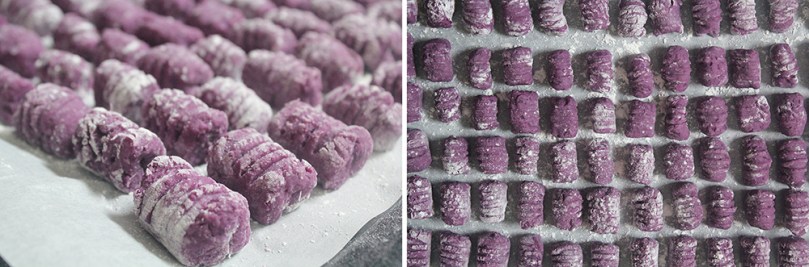
  3. Cut each log into 1-inch pieces and then press over the tine of a fork to create ridges. Transfer to a baking sheet dusted with flour and repeat with the remaining dough. I managed to make about 76 pieces of gnocchi with this recipe, more or less depending on how you roll them out/cut them.

Purple Sweet Potato Gnocchi

  1. Bring a large pot of generously salted water to a boil. Working in batches, add the gnocchi to the pot, gently stirring once or twice to prevent them from sticking. Cook until the gnocchi floats to the surface, about 3-5 minutes, and then cook for an additional 30 seconds. Remove using a slotted spoon and transfer to a tray lightly drizzled with oil. Set aside.
  2. Creamy Parmesan Sauce: Heat about a tablespoon of cooking oil over medium-high, in a medium-sized pan. Add garlic and sauté until fragrant, about 30 seconds. Immediately add in the onions and continue to sauté until fragrant and slightly golden in colour and onions have softened and begin to go translucent, a further 45 seconds.
  3. Add the cream and season with a touch of salt and freshly ground pepper. Mix and bring to a gentle simmer. Once simmering, add in the parmesan cheese. Mix until the cheese has melted and then remove from the heat.
  4. Assemble: Heat 2 tablespoons of cooking oil in a large frying pan over medium-high. Working in batches again, add the gnocchi to the pan and lightly fry until golden brown in colour.
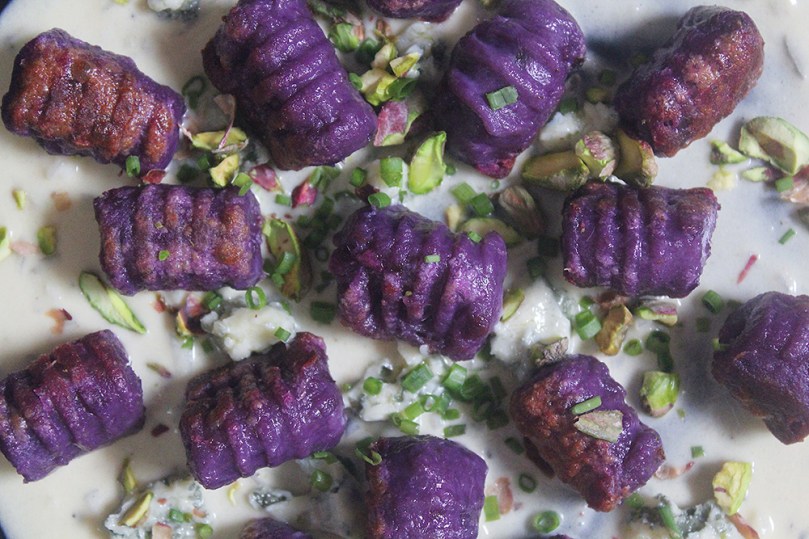
  5. Spread the creamy parmesan sauce on a serving dish, and place the pieces of fried gnocchi on top. Add crumbles of Danablu cheese* (or any other type of blue cheese) and top with roughly chopped pistachios, and chives.
  6. Serve immediately and enjoy!

Purple Sweet Potato Gnocchi with Creamy Parmesan Sauce, Danablu & Pistachios

This recipe for Purple Sweet Potato Gnocchi creates a vibrant and eye-catching dish that is as visually pleasing as it is delicious. You get the best of both worlds with the light, soft-pillowy interior and golden-crispy exterior in every mouthful. These gnocchi are a touch sweeter than those made from regular potatoes, and therefore are best complimented by salty and savoury flavours, like a Creamy Parmesan Sauce. Sharp, rich, and bold especially with the danablu cheese. Balance it out with a fresh squeeze of lemon juice to cut through the creaminess, and you’ve got yourself a killer dish!

Purple Sweet Potato Gnocchi with Creamy Parmesan Sauce, Danablu & Pistachios

BON APPÉTIT

– Ally xx
myTaste.com

Pulut Tai Tai (Blue Glutinous Rice Cakes)

Pulut Tai Tai (Blue Glutinous Rice Cakes)

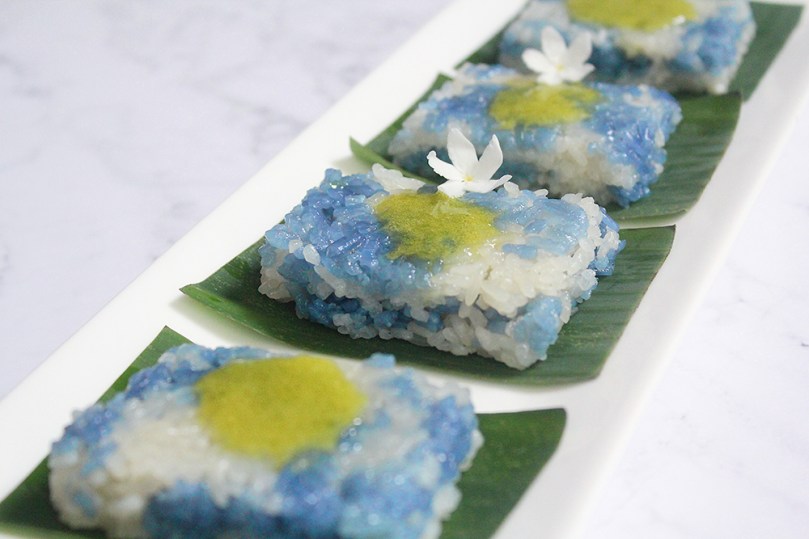
Hello Everyone! Pulut Tai Tai is a Nyonya kuih made of fluffy glutinous rice that is steamed in coconut milk, and tinted with a beautiful natural blue colour from butterfly pea flowers. You can leave it out if you can’t find butterfly pea flowers, as it’s mostly for the colour, but it wouldn’t be as elegant-looking without it.

It is typically served with a coconut-pandan spread where the contrasting colours of green together with the vibrant blue and white of the glutinous rice makes the kuih all the more delightful and pleasing to the eyes of the beholder. In addition to colour, the slight tinge of saltiness of the glutinous rice coupled with the sweetness of the kaya makes this kuih a delight to savour.

Pulut Tai Tai (Blue Glutinous Rice Cakes)

Tai Tai refers to a rich man’s wife who enjoys a life of leisure. It is said that this specific kuih was only served to the wives of rich men back then. This kuih is also known as Pulut Tekan which literally translates to ‘pressed glutinous rice.’

Before we dive into tonight’s recipe, please take the time to check out the original recipe for these Blue Glutinous Rice Cakes over on Bake with Paws by Yeanley.

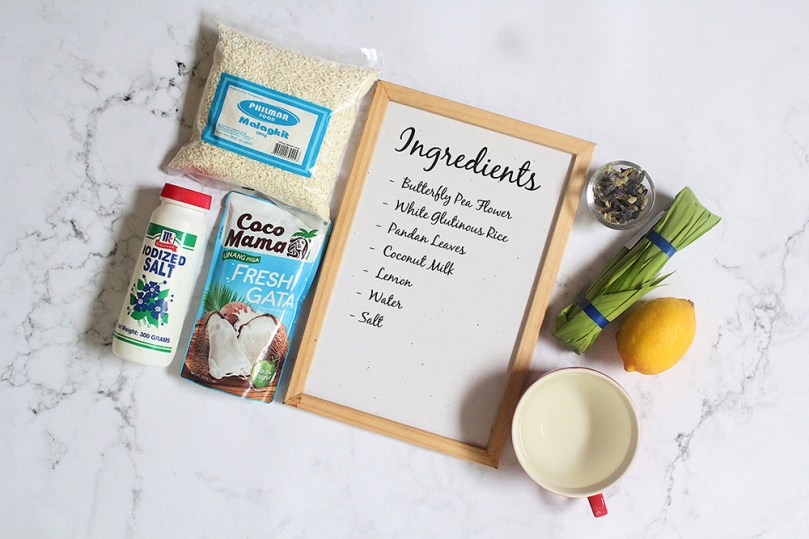
Before I tackled this recipe, I read that soaking the glutinous rice with the addition of vinegar or lemon juice will reduce the phytic acid found in the grain. It also helps in breaking down the gluten and aids for better absorption of the blue colour from the butterfly pea flowers. Now, while I included lemon in the ingredients shot below, I in fact did not use the lemon at all for one main reason – the addition of acidity to the butterfly pea flower infused water would make it turn violet in colour. Since I am all about sharing blue recipes for this month, that’s definitely not what I want. I found that the glutinous rice absorbed the blue colour well anyway without the need for vinegar or lemon juice.

Pulut Tai Tai (Blue Glutinous Rice Cakes) Ingredients

PREP TIME 20 MINS* | COOKING TIME 30-45 MINS | SERVES 4-6

* Additional 4 hours min. overnight max. for soaking time

INGREDIENTS

  • 2 cups white glutinous rice
  • 1 cup coconut milk
  • 2/3 cups water
  • 3/4 tsp salt
  • 25 pcs dried butterfly pea flowers
  • Banana leaves
  • Pandan (screwpine) leaves
  • Lemon juice (optional)

METHOD

  1. Bring a small saucepan of water and the dried butterfly pea flowers to a boil, over high heat. Let it simmer for a few minutes and then remove from the heat. Cover and leave to steep for 10 minutes before straining. Press down on the flowers to extract the blue colour from the flowers. Set aside to cool.
  2. Wash the glutinous rice until the water is clear. Soak 1/3 of the glutinous rice with the blue-infused water and the remaining 2/3 in water. Soak for at least 4 hours or overnight. After 4 hours or the next day, drain them both separately.
  3. Prepare your steamer by lining with clean banana leaves. Light grease with a touch of coconut oil and top with pandan leaves followed by the glutinous rice; blue rice on one side and white on the other.
  4. Mix the coconut milk and salt together. Pour half of the coconut milk mixture over the rice and mix well. Steam over high heat for 20 minutes. After 20 minutes, remove from the steam and fluff the rice. Add the remaining coconut milk mixture and then return it to the steamer to cook for a further 10 to 15 minutes.
  5. Line a square pan with banana leaves and lightly grease with coconut oil. Transfer the cooked rice to the pan, alternating between the white and the blue rice. Level the surface and cover with more banana leaves. Place another pan on top of it and weigh it down with heavy objects to compress the rice. Set aside to cool.
  6. Cut into small rectangular pieces and serve with some homemade Nyonya-style kaya. Enjoy it as a mid-afternoon snack!

This kuih can be kept for a couple of days if stored in the refrigerator. Before consuming it again, steam or heat it in a preheated oven at 70C for 10 minutes to soften it.

Pulut Tai Tai (Blue Glutinous Rice Cakes)

PS: Before I end tonight’s post, let’s see if a particular someone actually reads my blog from start to finish *cheeky grin* I would like to take this opportunity to wish a special person in my life, a Happy Birthday! I hope you like the little gift I had sent to you earlier this afternoon. I wish you an abundance of happiness, good health, peace, and prosperity in life. To many more birthdays and hopefully I can spend them all with you by your side!

BON APPÉTIT

– Ally xx

myTaste.com

Stir-fried Handmade Noodles with Spicy Tofu & Mushroom Mince

Stir-fried Handmade Noodles with Spicy Tofu & Mushroom Mince

Hello Everyone! I can’t believe that it’s already October – how did the months in quarantine fly by so fast? I felt like March was just last week! I hope everyone is staying safe at home, and only going out when necessary, for work or essentials. I still haven’t reported back to the office since our country declared enhanced community quarantine, and I hope that I won’t have to go back until this pandemic is under control.

That aside, I will continue sharing blue-inspired dishes for the month of October, and what better way than to kick things off with this recipe for Stir-fried Handmade Noodle with Spicy Tofu & Mushroom Mince. I initially drew my inspiration for this recipe by Blue Willow, a thematic bar and bistro located in Singapore that derives its inspiration from one of our favourite science-fiction movies of 2009 – Avatar.. Now, I haven’t been there myself, but when I was doing research earlier on this year to look for blue-inspired dishes, I came across Blue Willow’s Eywa Natural Blue Carbonara, where pasta dough is naturally coloured using butterfly pea flowers.

Chinese Handmade Noodles

My initial idea was to recreate this exactly as it is, a blue carbonara. As the months went by and drew closer to tackling this dish, paired with hours of research for new recipes (not necessarily just for this dish in particular), my idea shifted to making Chinese-style handmade noodles instead of pasta. To be honest, this was actually a recipe that I had initially planned for the third week of September, to serve with the Chinese Blue Tea Eggs (茶叶蛋) that I had also made earlier last month. However, I wasn’t happy with how the dish was put together, in terms of how I dressed the noodles. I didn’t want to share something that I wasn’t happy with, visually and taste wise, so it wasn’t until I did more research and tackled this dish once again towards the end of September – and finally something that I am happy to share with you guys!

Before we dive into tonight’s recipe, please take the time to check out the original recipe for Handmade Noodles over on The Woks of Life by Sarah, one of a family of four cooks. Also, check out the original recipe for Tofu and Mushroom Mince over on Scruff And Steph by Scruff.

The making of the noodles really tired me out for they were kneaded, rolled, and cut from scratch, and all by hand. If you have a mixer with a dough hook attachment, it’ll be a piece of cake! If not, you need a bit (lot) of elbow grease, and you’ll be making noodles the same way cooks have been making them in China for centuries.

PREP TIME 1 HOUR | COOKING TIME 30 MINS | SERVES 4

INGREDIENTS

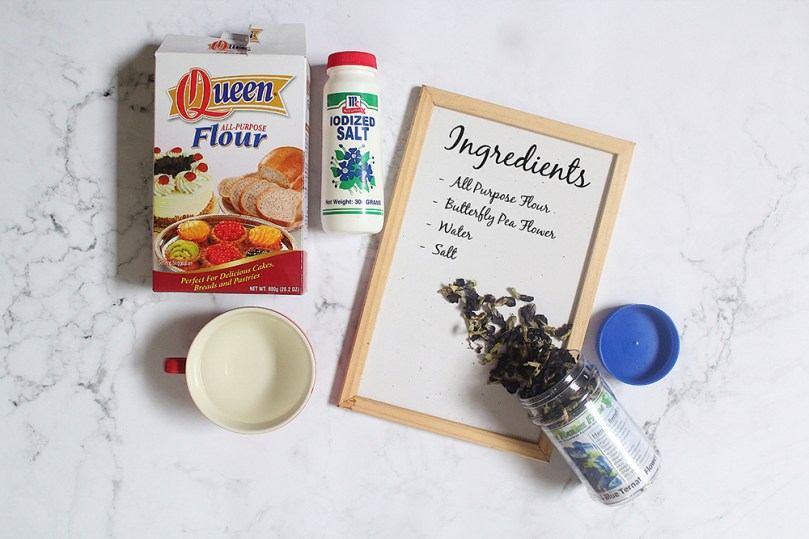
Chinese Handmade Noodles Ingredients

For the handmade noodles

  • 3 cups all purpose flour
  • 1 cup water
  • 1 & 1/2 tsp loose dried butterfly pea flowers
  • 1/4 tsp salt

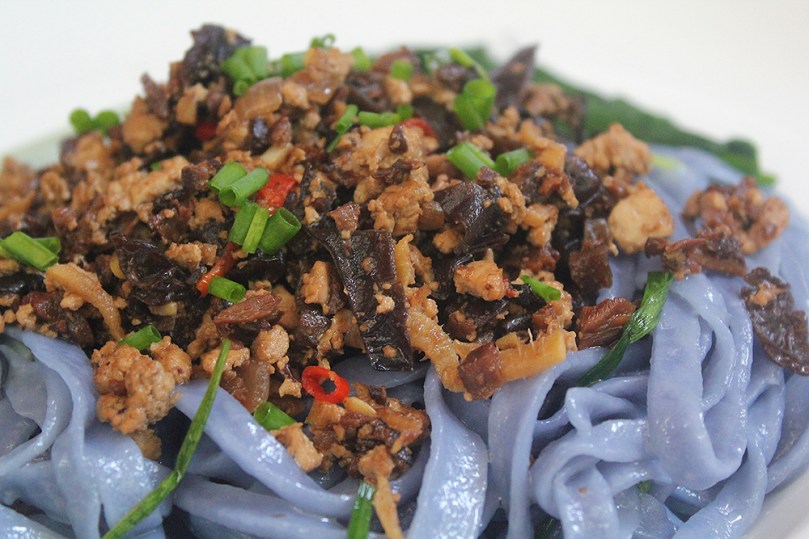
Stir-fried Handmade Noodles with Spicy Tofu & Mushroom Mince Ingredients

For the spicy tofu & mushroom mince

  • 250g firm tofu, mashed
  • 1/2 cup dried sliced shiitake mushrooms, rehydrated finely minced
  • 1/2 cup dried wood ear mushroom, rehydrated and roughly chopped
  • 2 garlic cloves, minced
  • 2 red bird’s eye chillies, minced
  • 1 small red onion, minced
  • 1 thumb-sized ginger, julienned
  • 2 tbsp coconut oil
  • 2 tbsp sesame oil
  • 1 tbsp light soy sauce
  • 1 tbsp sweet soy sauce
  • Salt and freshly ground black pepper, to taste

For the stir-fried noodles

  • 3 tbsp sesame oil
  • Spring onion stalks, white part only

To serve with

  • Chinese greens of choice
  • Spring onions, for garnishing

METHOD

  1. Handmade Noodles: Combine the dried butterfly pea flowers in a small saucepan together with the water and salt. Bring to a boil over high heat. Once boiling, turn the heat off and leave to steep for about 10-15 minutes. Discard the flowers and set aside to cool down completely.
  2. Add the all purpose flour to a large plate (or even directly onto your clean kitchen countertop). Create a well in the middle and bit by bit, pour the blue water into the flour, mixing with a pair of chopsticks, spatula, or even just your hand as you go. Once all the water is added, the dough should be in shaggy threads with little/no dry flour in the bowl.
  3. Begin pressing the dough together. Avoid the temptation to add additional water, as this will affect the texture of your noodles. If you find the dough is too dry and there’s still dry flour that’s hard to incorporate into the dough, drizzle just enough water until there’s no dry flour left. Knead the dough for about 15 minutes.
  4. Cover the dough with plastic wrap and set aside to rest for about 30 minutes. During this time, it will continue to absorb moisture, and become more pliable and elastic.
  5. Spicy Tofu & Mushroom Mince: While the dough is resting, heat oil in a large frying pan over medium. Add in the ginger together with the red bird’s eye chillies and sauté until fragrant, about 45 seconds. Immediately add in the garlic, continuing to sauté until fragrant and slightly golden in colour before adding the onions. Cook until the onions have softened and begin to go translucent, a further 45 seconds.
  6. Add the mashed tofu, shiitake and wood ear mushrooms. Continue to stir and cook for 5 minutes and then add in the light and sweet soy sauce. Season with salt and freshly ground black pepper, and stir the tofu-mushroom mixture around for a further 10 minutes. Taste and adjust the seasoning to your liking. Set aside and cook your noodles.

Chinese Handmade Noodles

  1. Stir-fry Noodles: After the dough has rested, knead it a few more times to get any air bubbles out of it, about 2-3 minutes. Form into a ball and cut it in half.
  2. On a floured surface, roll one half of the dough into a thin sheet, about 2mm thick. Flour the surface of the sheet thoroughly, flip over, and thoroughly flour the other side. Once floured, fold the dough so you have 4 layers. Slice the noodles with a sharp knife to your desired thickness. As you’re cutting the noodles, gently separate them out with your hands and toss them in flour so they don’t stick.
  3. Bring a pot of water to a boil and cook the noodles for 1 to 3 minutes, depending on the thickness. Keep an eye on the noodles as they cook and taste them to determine when they’re cooked. There is a lot of variation depending on how thinly they were rolled and cut, so test in real time to determine when they’re done. Drain and rinse under cold water. Set aside.
  4. Add sesame oil in a separate frying pan over high heat until smoking. Add the spring onion stalks together with the boiled noodles and fry for about 3-4 minutes.
  5. Transfer to individual serving dishes and top with the Spicy Tofu & Mushroom Mince. Garnish with spring onions and serve with Chinese Greens of your choice. Enjoy!

Stir-fried Handmade Noodles with Spicy Tofu & Mushroom Mince

You can also follow the recipe for Chinese Handmade Noodles and basically make anything and everything with them! These deliciously chewy, springy noodles can be served in soup or mixed with whatever tasty sauces and toppings you can dream up for a delicious meal. Here are just some key tips for success:

  • Use bread flour (high gluten flour): The way to get a good chew in your noodles is to develop the gluten in the dough. Using flour with high gluten content makes a big difference. That being said though, all purpose flour works fine too.
  • Don’t add too much water: The dough will look rather dry and lumpy at first, but do resist the temptation to add additional water. Too much water will make the noodles gummy rather than springy. You just have to have faith and give the flour enough time to absorb moisture through kneading.
  • Use lots of flour when rolling and cutting: The action of cutting the noodles with a knife will press the layers of dough together. To prevent them from sticking, be sure to thoroughly flour both sides of the dough before folding and cutting. This is another reason to avoid using too much water in the dough – to prevent it from sticking.
  • Be mindful of thickness: The noodles will expand when cooked, so whatever thickness you see when cutting the raw dough, the cooked noodles will be significantly thicker. Keep this in mind when rolling and cutting. You may want to roll the dough out thinner and cut the noodles thinner than you initially think.

Storage Tips:

  • Cooked Noodles: If you plan on reheating, you can slightly undercook the noodles (to al dente) to create a better texture once reheated. Store the noodles in an airtight container or a ziplock bag in the fridge for up to 3 days or in the freezer for up to 3 months.
  • Frozen Dough: Let the frozen dough thaw in the fridge overnight. Transfer the refrigerated dough to room temperature and let it rest for 2 hours. The dough will become super soft and can be gently shaped, rested for another 10 minutes or so, and rolled. Follow the method stated above to cook.

Stir-fried Handmade Noodles with Spicy Tofu & Mushroom Mince

BON APPÉTIT

– Ally xx

myTaste.com