Crispy Pata (Deep-fried Pork Leg)

Crispy Pata (Deep-fried Pork Leg)

Hello Everyone! After spending the past month in the Philippines, I thought that it’d be a good idea to share some of the foods that I came across and ate along the way. A classic dish that I will be sharing with you is the very famous Crispy Pata, or Deep-fried Pork Leg. Crispy Pata can be found in most eating places in the Philippines; one place that we dined at while staying Lucena City specialises in this dish and is even called Bubbles Crispy Pata & Restaurant. I remember the first time I came here with my cousins from the Barrientos side, my cousin JR joked about ordering a crispy para dish EACH. I think we ended up ordering one between two people, which, looking back, in my opinion is still quite a lot to eat between two; but just like me, he loves him some crispy pata. What I love about this very simple dish, is the crispy skin and of course the very tender meat beneath that layer of crispy goodness.
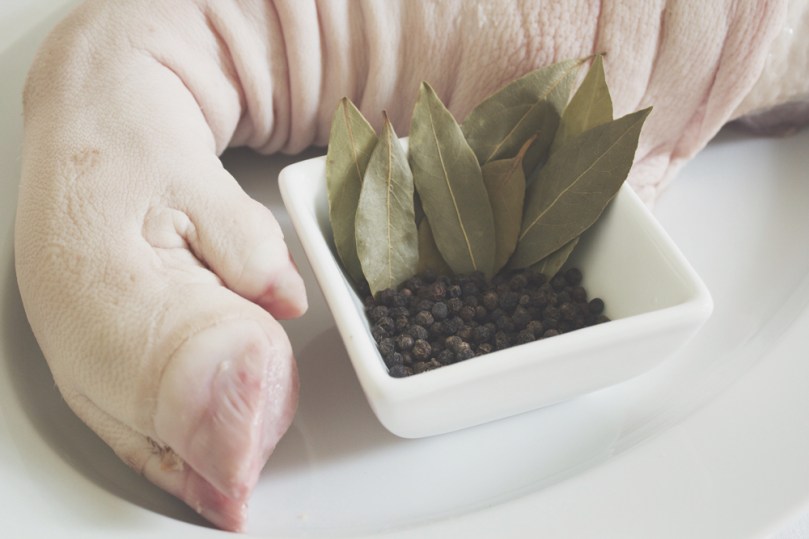
Crispy Pata (Deep-fried Pork Leg) Ingredients

As you probably would’ve already figured out from my description above, and the photographs, Crispy Pata is a famous Filipino pork dish that uses a whole pig’s leg. The leg (or pata) is made tender by simmering in water along with other spices, mainly peppercorns and bay leaves. It is then deep-fried until the texture becomes very crunchy. The dish is then served with various dipping sauces, the main being a soy-vingear sauce with chopped onions, or along with some pickled green papaya known as atchara, served as either a main dish with steamed rice, or as beer food known as pulutan.

Crispy Pata is definitely an easy dish to cook, but be cautious as the process does involve dangerous steps. Deep frying a whole leg can cause the hot oil to be uncontrollable. It is a must to slightly (not fully, as the cover can pop-up due to pressure) cover the cooking pot while frying. What my mom does is that instead of submerging the whole leg in scalding hot oil, she adds enough oil to submerge at least half of the leg and fries it for about 15 minutes or until golden brown. She then cautiously turns the leg and fries the other side for the same amount of time in medium heat until it becomes crispy. This is quite possibly one of the reasons why I only ever have crispy pata at a restaurant or when I’m home and my mom is there to do it for me – I don’t like the frying process!
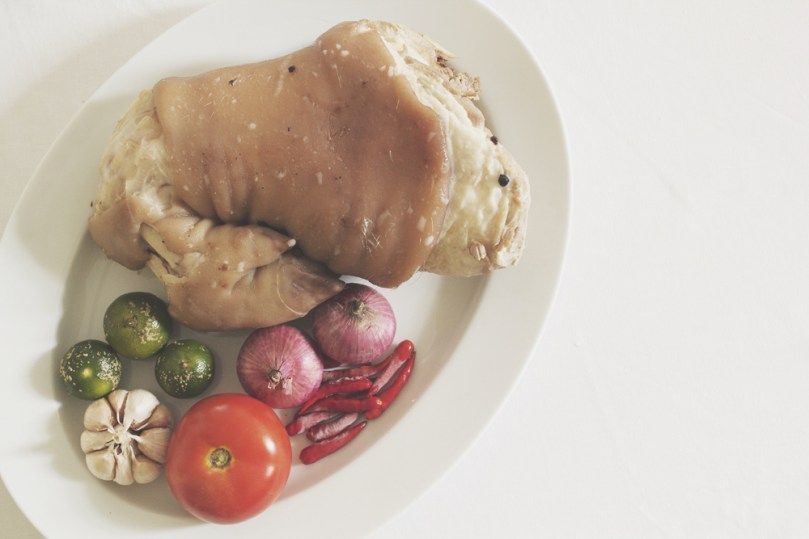
Crispy Pata (Deep-fried Pork Leg) Ingredients

PREP TIME 24 HOURS* | COOKING TIME 2 HOURS 30 MINS | SERVES 4

*Includes setting aside the boiled pork leg in the fridge overnight to draw out the moisture before deep-frying.

INGREDIENTS

  • 1 whole pig’s leg (about 2 or 2.5kg)
  • 12 to 15 cups water
  • 8 to 12 cups cooking oil
  • 6 pcs dried bay leaves
  • 2 tbsp whole black peppercorns
  • 1 & 1/2 tsp salt

For the soy dipping sauce

  • 1/3 cup dark soy sauce
  • 1 small red onion, diced
  • 1 small tomato, diced
  • Juice of two calamansi**

For the vinegar dipping sauce

  • 1/3 cup white vinegar
  • 3 cloves garlic, crushed
  • 3 red bird’s eye chillies, halved
  • Whole peppercorns

**Calamansi (or calamondin), is a hybrid between a mandarin orange and a kumquat. It is widely cultivated in the Philippines and primarily used in cooking to flavour foods and drinks. If calamansi isn’t available, you may substitute it with lemon or lime, but the taste will not be the same. I can’t say exactly what the difference in taste is, but I think calamansi is a tad more sour than a lemon/lime, and has a slight orange taste to it.

METHOD

  1. Pour water into a large cooking pot along with the bay leaves and peppercorns. Bring to a boil. Once boiling, add in the whole pork leg and simmer under mediumm-high heat until the leg becomes tender (about 1.5 to 2 hours).
  2. Remove the tender leg from the cooking pot, transfer to a plate large enough to fit it and set aside until the temperature goes down. Once it has cooled down, place a clean cloth above the leg and refrigerate overnight. Remove from the fridge a few hours before cooking to bring it back to room temperature. Some recipes I’ve seen don’t require you to refrigerate the meat, I do it so that it draws out excess moisture from the leg.
  3. At this point you may want to rub on some different spices such as garlic powder, ground black pepper, and salt onto the skin. If you do, let it stand for 15 minutes for the leg to absorb the rub. If you don’t want to season it any further, which is what I did, then you can move onto frying.
  4. Heat a clean large cooking pot (preferably with cover), over high heat and pour the cooking oil in. When the oil becomes hot, turn the heat down to medium high. Carefully lower the leg into the hot oil and deep fry. Cook until one side becomes brown and crispy, about 10 to 15 minutes, and then cautiously flip the leg to brown and crisp the other side. Be extra careful in doing this procedure.
  5. Turn the heat off and remove the crispy pork leg. Transfer it to a wide serving plate.
  6. Combine all the ingredients together for the separate dipping sauces dance serve together with the crispy pata!

Crispy Pata (Deep-fried Pork Leg)

BON APPÉTIT

– Ally xx

myTaste.com

Oxtail Kare-Kare

Oxtail Kare-Kare

Hello Everyone! So I was just browsing through all the posts I’ve uploaded since I got into a regular uploading schedule and I realised that I actually haven’t posted a savoury dish in a while. I’ve been posting about cakes, cookies, and muffins these past few months! The last savoury dish that I blogged about was back in October with The Ultimate Brekkie (for those who have not seen it, click on it and prepare to drool, seriously).

Today’s recipe is a little different, or may be different to some of my readers/viewers. It is one of my most favourite dishes of all time, and only because my mom used to make it on a regular-enough basis to always have this orgasmic sensation with every bite. It may not suit the taste buds for many I feel, but seriously, every person I’ve made this for, well okay 3 people, loved it so much that they’ve even gone and tried to make it for themselves!

There are a few things to cover in this recipe that many may not know about, so I’ll start of with what even is Kare-Kare. Pronounced kah-reh kah-reh, it is a traditional Philippine stew flavoured with ground roasted peanuts or peanut butter, onions, and garlic; creamy, rich, and thick. Traditionally, a palayok (clay cooking pot) is used to cook this dish and it is also used as the serving pot. Typical meats that make the base for this stew include oxtail (sometimes this is the only meat used), pork hocks, calves feet, pig feet, beef stew meat; and occasionally offal, or tripe, rarely goat or chicken. Besides the meat, vegetables are also cooked with the stew and these include a range of (but are not limited to): eggplant, Chinese cabbage (or other leafy greens), long beans, okra (lady fingers), daikon, etc. – usually equaling or exceeding the amount of meat in the dish. The overall dish is then coloured (and flavoured) with annatto seeds, which is extracted by add the seeds in oil or water. Since I didn’t have some in handy, I just left them out – I feel like it didn’t have a significant effect to the overall flavour of the dish.

This dish is often served and eaten with shrimp paste known in a Philippines as bagoong (pronounced ba-go-ong). Sometimes it is spiced with chilli, or sautéed with garlic, onions, tomatoes, and sprinkled with calamansi (small round lime) juice. Bagoong paste varies in appearance, flavour, and spiciness depending on the type. Pink and salty bagoong is marketed as “fresh”, and is essentially the shrimp-salt mixture left to marinate for a few days. I sautéed a whole jar of shrimp paste and only used about a generous tablespoon of it on the side for this dish. The rest I put back into the jar and into the freezer until for later use. There are many other dishes that you can make with the sautéed shrimp paste and it may pop up in my blog a few more times!

I cooked up this dish for our supposed International (Asian) Feast Night that we had been planning for a while. I say “supposed” because instead of having food from 5 different Asian Cuisines, we ended up only having 3 and it turned out to also be Lydia’s farewell dinner. Basically Lydia cooked a dish from China, Vidhya from India, and me from the Philippines. Jialing (who did not show up by the way because she had a staff dinner) was supposed to make a dish from Malaysia, and Marissa, who already went on holiday, was supposed to make a Vietnamese dish. I was seriously so tired that night, I mean first of all, I had just come back from my Outback trip and only felt the tiredness after returning back. Secondly, I worked from 9am-5pm that day, and when I got home, I straightaway went into the kitchen to cook. I was SO tired that I actually seriously fell asleep at the table after dinner, during dessert. Talk about an induced food coma!

So for this night, which by the way happened about 3 days after I got back from the Red Centre, I decided to make my famous Oxtail Kare-kare. I also made a chicken version for Vidhya because the only meat she eats is chicken (and fish). I’ve never actually tried the dish with chicken before; it turned out okay but in my honest opinion, it wasn’t as flavourful as the Oxtail. I have made this dish in the past as well where I used pork hock/leg, pork shoulder, beef shank or gravy beef, and my mom made it a few times with beef tripe – all these cuts of meat work perfectly well with the dish. Some butchers sell oxtail either whole or cut. If your local butcher happens to seek them whole, just kindly ask them to cut it into rounds for you, that’s what I did. I remember as a little kid that I would always love the bigger cuts because they had more meat in them… Until someone ruined it for me saying that “the bigger the cut, the closer it is to its bum!”

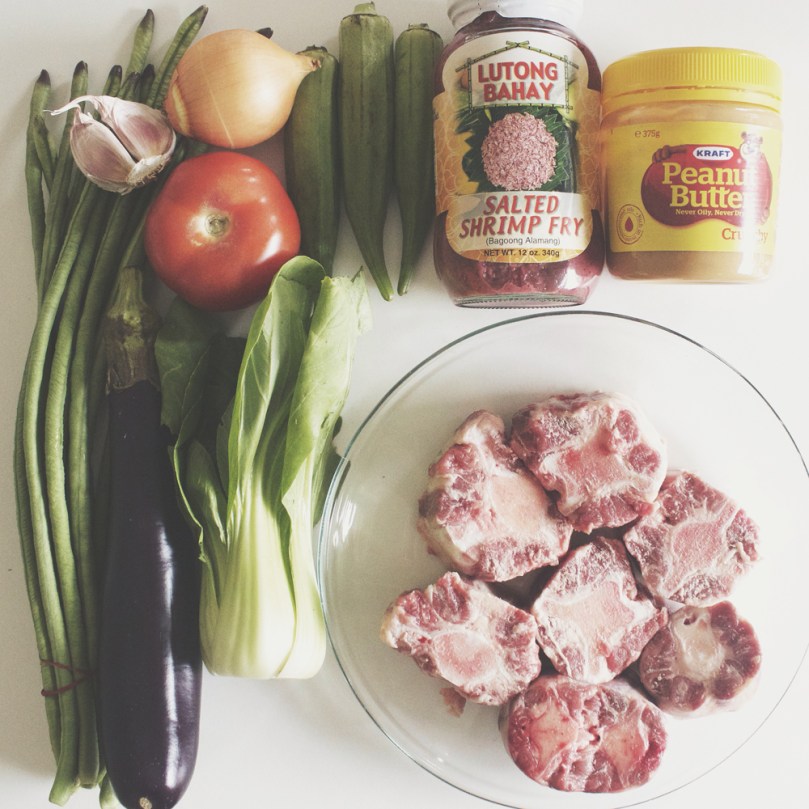
Oxtail Kare-Kare Ingredients

PREP TIME 10 MINS | COOKING TIME 1 HOUR 45 MINS | SERVES 4-6

INGREDIENTS

For the stew

  • 1kg oxtail, cut into rounds
  • 2 cups beef stock
  • 5 dried bay leaves
  • 3 garlic cloves, crushed then minced
  • 1 large onion, halved and then sliced
  • 1 tbsp crunchy peanut butter (a very generous tablespoon)
  • 1 tsp rock salt
  • 1 tsp whole black peppercorns
  • Ground salt and pepper
  • Buk Choy, separated
  • Eggplant, sliced diagonally
  • Long beans, cut into 1-inch long strings
  • Okra (lady fingers), whole and then sliced later once cooked

For the sautéed shrimp paste

  • 345g bagoong alamang (shrimp paste)
  • 3 garlic cloves, crushed then minced
  • 2 large tomatoes, diced
  • 1 large onion, halved and then sliced
  • 1 tbsp sugar

METHOD

  1.  Add the oxtail, bay leaves, rock salt and whole peppercorns to a large pot with about a litre of water, or enough to submerge the meat. Boil for about 1 to 1 and a half hours until tender. If you are using a pressure cooker (which I don’t have), 30-35 minutes should do the trick! Once the meat is tender, remove from the heat and set aside. Do not throw away the stock.
  2. While your meat is tenderising, move onto sautéing the shrimp paste. Heat oil in a medium-sized frying pan and sauté garlic and onions until fragrant. Add the tomatoes in and sauté until they have softened. Add the shrimp paste in and give it a good mix. Add in the sugar and let it simmer for about 5 minutes. Turn the heat off and set aside. You may need to heat it up again before serving.
  3. Heat oil over medium-high heat in another pot and sauté the garlic and onions until fragrant. Add the the oxtails, season with ground salt and pepper, and give it a good stir. Add the peanut butter to two cups of the stock and stir until the peanut butter has softened. Add the peanut butter mix to the oxtail and bring the heat to low. Let it simmer for about 8-10 minutes. If you want your stew to be less creamy and thick, add more stock to your liking.
  4. Meanwhile, bring a medium pot of salted water to a boil and cook your vegetables for no longer than 5 minutes. Drain and transfer the cooked vegetables to your oxtail stew just before serving. Serve hot with sautéed shrimp paste and enjoy!

Oxtail Kare-Kare

BON APPÉTIT

– Ally xx

myTaste.com

Leche Flan (Crème Caramel)

Leche Flan (Crème Caramel)

Hello Everybody! Today’s recipe is definitely one of my favourite desserts and hands-down a crowd pleaser. It is one of the most-made desserts this year, today being the 4th time and in 3 consecutive weeks in June. Each and everyone of my friends love it, crave it and always look for it whenever I’m around during house parties. I’m pretty sure I’ll be making a lot of people happy by posting this recipe today – hint: Pam, Rachel, and Francesco.

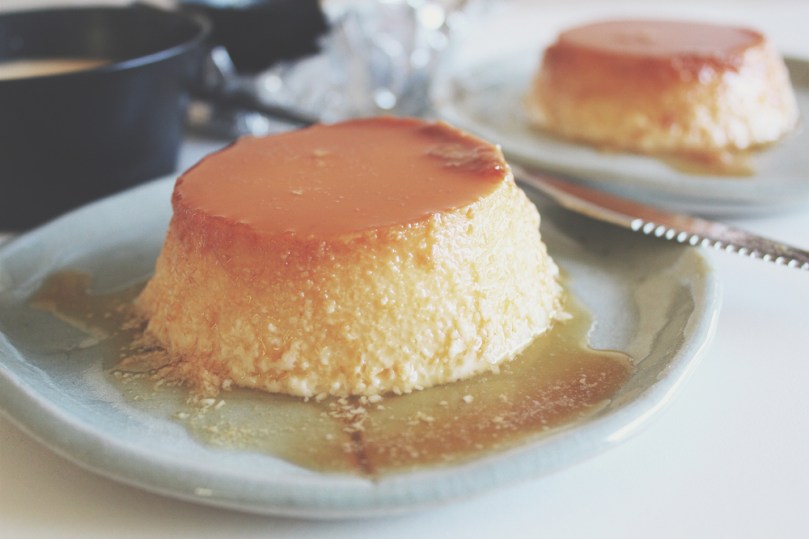
Leche Flan, or also known as Crème Caramel, is a rich and heavenly dessert (the way I make it of course), made up of egg yolks and milk with a soft caramel top. It is widely known throughout the world (especially in Europe) and has been in the dessert menu of most restaurants because of its convenience in preparation – and it really is that simple! In the Philippines, celebrations such as parties and town fiestas won’t be complete without it.

Leche Flan (Crème Caramel) Ingredients

PREP TIME 5 MINS | COOKING TIME 25 MINS MAKES 6 MINI FLANS

INGREDIENTS

  • 6 egg yolks, at room temperature
  • 1 can (395g) condensed milk, at room temperature
  • 1 cup milk, at room temperature
  • 6 tsp caster sugar
  • 1 & 1/2 tsp vanilla extract

Yes, you only need 5 ingredients! And makes 6 small, round flans. Working with ingredients at room temperature is ideal as I found that when I made them with chilled ingredients, the egg yolks started to form and you’ll then find lumps of egg yolk in your flan.

METHOD

  1. Add one teaspoon of sugar to each round metal mould. Caramelise the sugar by placing the mould on the stovetop. Mix thoroughly until the solid sugar turns into liquid (caramel) and turns light brown in colour. Be careful as the sugar can easily burn. Set aside to wait for the caramel to fully solidify and cool down.
  2. In a large bowl, whisk the egg yolks and vanilla extract together. Then whisk in the condensed milk, and finally the milk until well combined. You may see tiny bits of egg yolk starting to form. If so, strain the mixture through a sieve into another bowl.
  3. Pour the mixture equally into the moulds and cover the tops with foil (this is to prevent any water droplets from the steaming process dripping nto the mixture – trust me, I’ve done this once before and I got very watery flans).
  4. Place in a steamer and steam for 15 minutes. Once done, turn the heat off and leave it in the steamer for a further 10 minutes. Remove from the steamer and set aside to cool down before placing them in the refrigerator for at least 4-5 hours before serving.
  5. To plate up, run a butter knife around the edges of the flan, place a serving dish on top of the mould, invert, and enjoy!

Leche Flan (Crème Caramel)

BON APPÉTIT

– Ally xx

myTaste.com

Paksiw na Lechon Kawali

Paksiw na Lechon Kawali

Hello everyone! This is another Filipino dish that I really love. I have a lot of favourite Filipino dishes actually, but there are some that I cannot bring myself to eat – I’m pretty sure they taste good, but a little bit off putting for me, and yes, I am talking about the infamous dinuguan (a savoury stew of meat and/or offal, simmered in a rich, spicy dark gravy of pig blood, garlic, chilli, and vinegar). I get the shivers every time I think about this dish. Anyway, enough about this dish for it’s thankfully not what today’s post will be about.

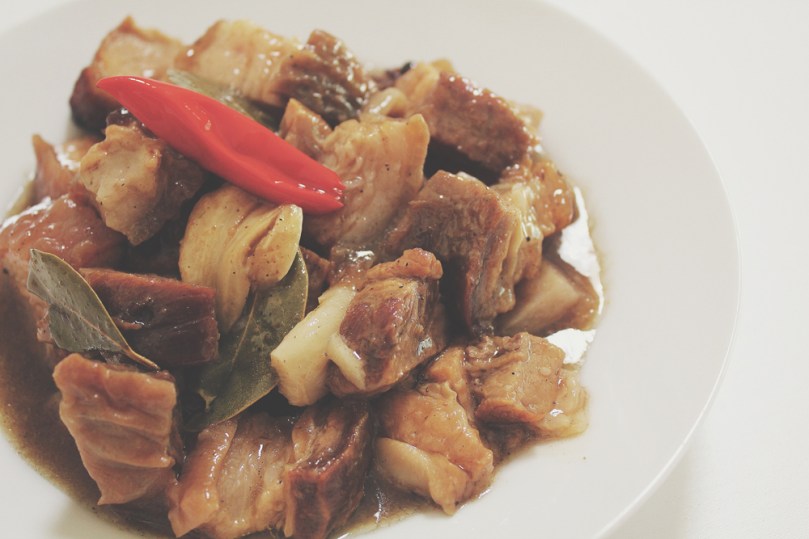
Lechon Kawali is basically a pan-roasted pork dish popular in the Philippines. It is usually accompanied by sarsa ni mang tomas (basically a sauce blend of liver, vinegar and spices that give that distinct sweet and spicy taste it is famous for), ketchup, or soy sauce with calamansi (Philippine lime). Lechon kawali is cooked by boiling then later deep frying a portion of the pig.

Lechon Paksiw is essentially a term associated to a dish that is cooked with vinegar, garlic, onion, and sarsa ni mang tomas sauce. It is a pork dish made from leftover roast pig which is known as Lechon. However, fresh pork can also be used to make lechon kawali. Traditionally, as mentioned above, the pork is deep fried. Because I don’t like deep frying stuff, I roasted the pork in the oven like I would do for pork crackling – the result I find is better, not oily and the meat remains tender and juicy on the inside where as deep frying has a tendency to make the meat tough and dry.

Paksiw na Lechon Kawali

PREP TIME (see below)* | COOKING TIME 1 HOUR 20 MINS |
SERVES
4-6

*If you plan on making dish, plan for about 1-3 days ahead for resting time in the refrigerator.

INGREDIENTS

  • 1kg fresh pork belly or shoulder
  • 1 bottle (330g) mang tomas all purpose sauce
  • 6 cloves garlic, peeled and crushed
  • 3 bird’s eye chillies
  • 3/4 cup white vinegar
  • 1 cup pork stock
  • 1 tbsp white sugar
  • 6 dried bay leaves
  • 2 tsp whole black peppercorns
  • Ground salt
  • Oil for rubbing

METHOD

  1. Score the skin with a very sharp knife. Place the meat in a large pot with water, 1 tsp of the whole peppercorns and half of the bay leaves. Boil for 20 minutes. Remove from the heat and drain, placing in a large bowl and let to cool to room temperature. Reserve the pork stock for cooking later. Once the meat has cooled down, refrigerate uncovered for at least 24 hours or for up to 3 days for a better result. Refrigerating the meat will help to draw out any remaining moisture. Remove from the refrigerator and bring back to room temperature prior to roasting in the oven
  2. Preheat oven between 220-240C. Rub oil and plenty of salt into the scored skin, really getting it into the slits of the score marks. The fat under the skin will react to the salt and that is what makes the skin puff up and crisp up. Roast in the oven for 20 minutes and then bring the temperature down to 160C and roast for another 10 minutes. Remove from the oven and let the meat rest for 20 minutes. Then cut the pork into chunks.
  3. Add all the remaining ingredients into a large pot together with the pork belly chunks. Simmer for 20 minutes and then serve with steamed rice.

Paksiw na Lechon Kawali

BON APPÉTIT

– Ally xx

myTaste.com

Pork Spare Ribs Sinigang

Pork Spare Ribs Sinigang

Hello everyone! So I realised that I haven’t actually posted any Filipino recipes since starting this blog. For those of you who don’t know, a big part of my diet consists of delicious homemade Filipino food cooked by my Mama while growing up. Her food was always the best. And today I want to share with you a nice sour soup that’ll definitely warm up your insides during a cold winter. Well, growing up in the tropics didn’t stop us from having a nice bowl of this soup! I’m actually quite proud to be Filipino because there is nothing that I love more than Filipino food.

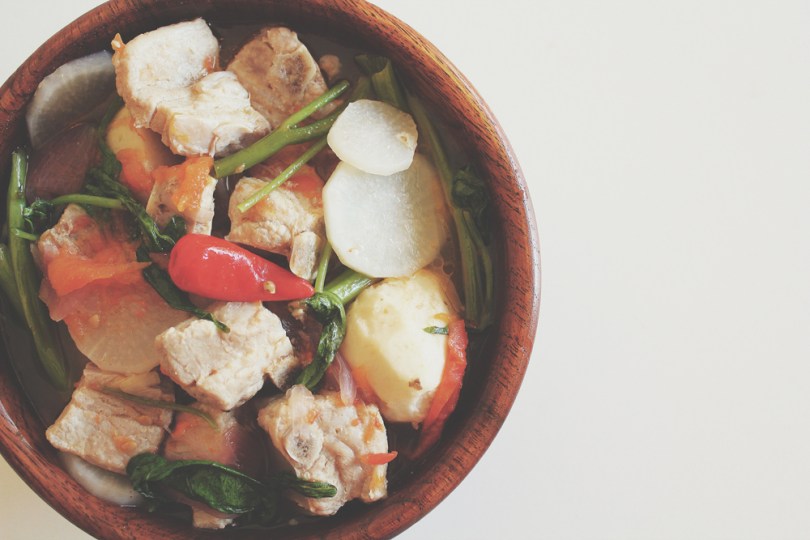
Sinigang is characterised by its sour and savoury flavour that is traditionally tamarind based. There are other base variations where the soup obtains its sourness from such as guava, calamansi, bilimbi, or unripe mango. Seasoning powder or bouillon cubes based on tamarind is also used in place of natural fruits. This dish can be made with any type of meat ranging from fish, pork, beef, shrimp, or chicken, stewed with tamarinds, tomatoes, and onions as its base. The dish is then accompanied with various vegetables such as okra, gabi (baby taro), daikon (white radish), kangkung (water spinach), snake beans, and eggplant. Often, chillies or peppers would be added to the dish in order to enhance the taste while adding a little spice.

PREP TIME 10 MINS | COOKING TIME 1 HOUR 15 MINS SERVES 4-6

INGREDIENTS

  • 1 kg pork spare ribs
  • 2 small spanish red onions, quartered
  • 2 red bird’s eye chillies
  • 1 large tomato, cut into wedges
  • 1 medium sized daikon, peeled and sliced
  • 5 small baby taro, peeled
  • 1 bunch kangkung, washed, leaves separated from the stems, and stems cut into short lengths
  • 1 tbsp tamarind soup base
  • Ground salt
  • Fish sauce (optional)

METHOD

  1. Add the pork ribs into a large pot with water filled to about halfway. Boil the ribs on high heat for 30 minutes, then add the chillies, onions, tomatoes, and season with salt. Boil for another 30 minutes.
  2. Add the baby taro and let to simmer for 5 minutes before adding the daikon in. Simmer for another 5 minutes. Remove 2 of the baby taro and push them through a sieve. Return to the soup to thicken the base and make it richer (this is optional).
  3. Add the tamarind soup base, if you want your soup a little less sour, add in a teaspoon at a time to adjust to your liking (I love my sinigang soup really sour!). Add a few drops of fish sauce if the soup is tasting a bit bland.
  4. Remove from the heat and add the kangkung in. Serve immediately with rice.

Pork Spare Ribs Sinigang

Filipino is not a very famous cuisine as that of its Thai and Vietnamese neighbours. I only know of one Filipino restaurant here in Sydney, and only 1 grocer in Chatswood that sells all things Filipino. Otherwise there are only a small selection of Asian grocers that carry Filipino ingredients like mang tomas sauce, bagoong, tamarind soup base, etc. There’s more to Filipino food than the mind-boggling balut (duck embryo) as we are blessed with an abundance of seafood, tropical fruits and creative cooks. Also, with more than 7,000 islands and a colourful history, we have some delicious dishes of our own.

BON APPÉTIT

– Ally xx

myTaste.com